Well, it’s the 10th of July 2023 and Judy and I are heading North on our next trip into the Centre and across to Western Australia. Driving up to Alice Springs and Katherine in the NT will give us access to Kununurra and Purnululu in the West. A round trip of about 8-10,000 Kms through arid zones and the subtropics. Hopefully we will avoid a repeat of the cyclone that badly affected the Kimberley, Northern Territory and Queensland; and which also determined our route to the West. We shall see…
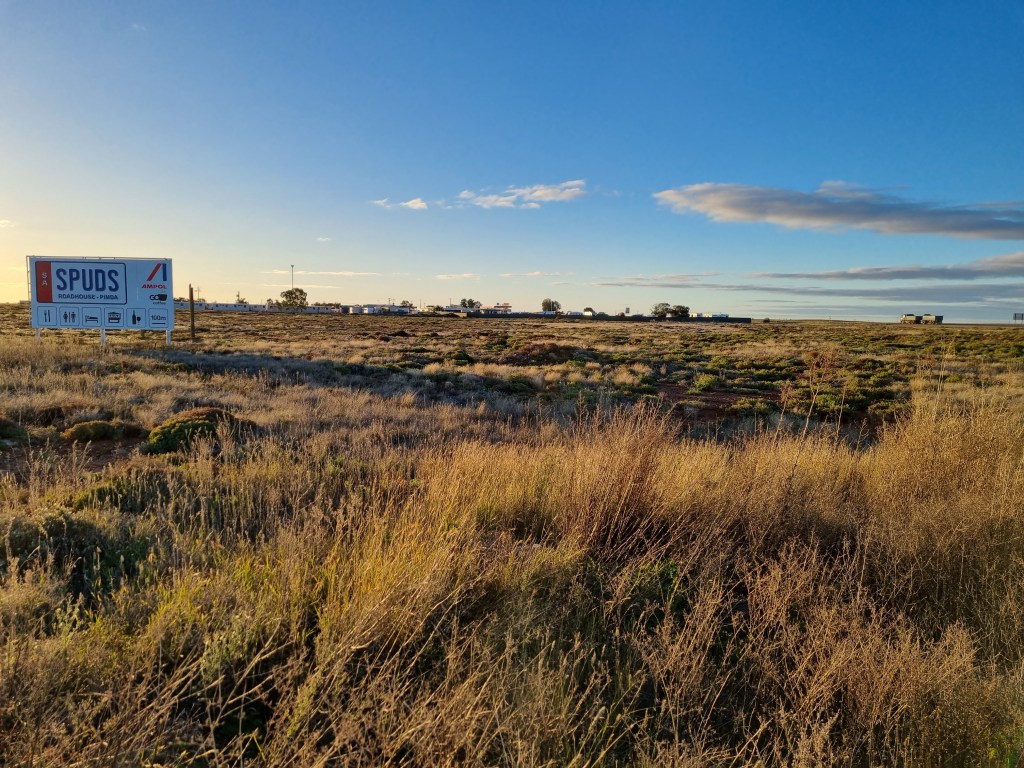
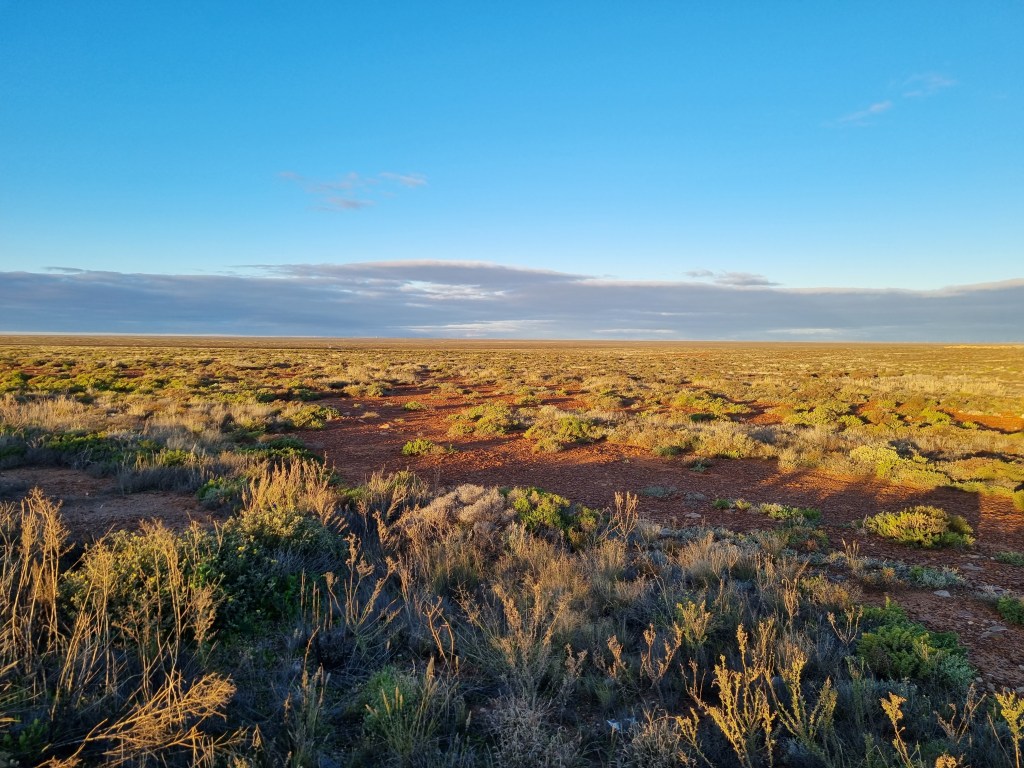
Adelaide was a misery yesterday as we packed and again this morning. But we are well North of Pt Augusta now and have settled at an iconic, albeit rather “daggy” roadhouse and campground called Spuds at Pimba. Woomera a township famous for its role in rocket launchings and now space exploration is close by. The sky is clear at last, and I have a feeling we will see plenty of sunshine from now on…even though it may be cold. You will notice that this zone features treeless plains. Clearly, we are heading into more remote zones.
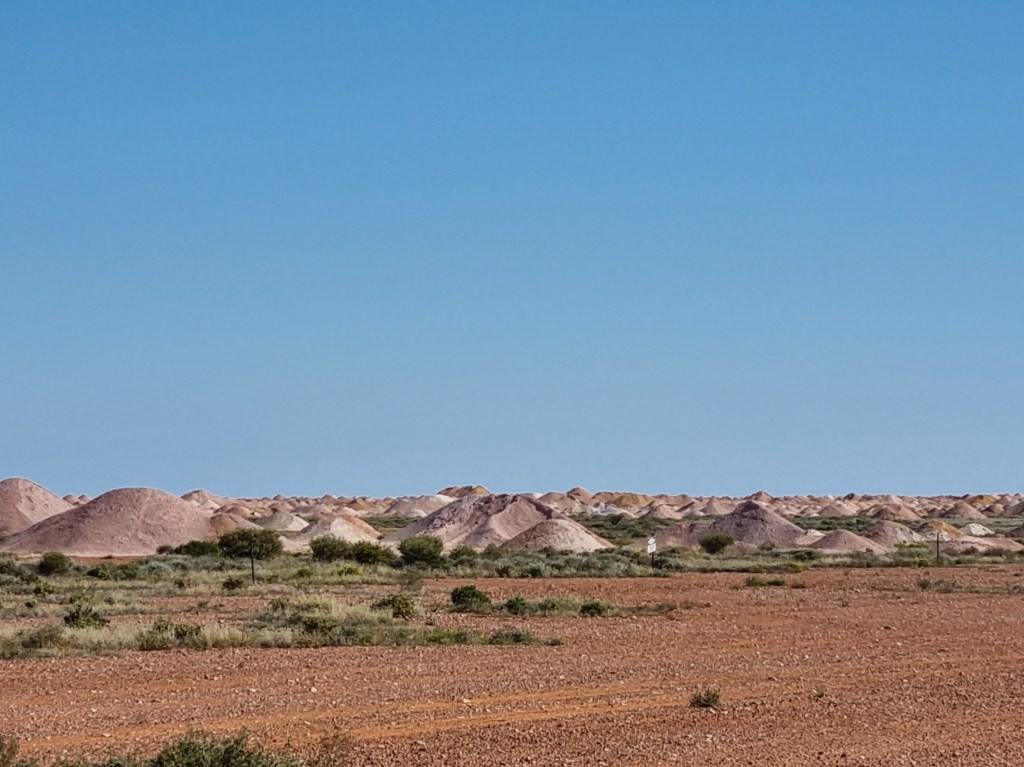
Week 1. The next day is decidedly sunny as we pass by Lake Hart a normally dry Salt Lake now filled with water. Indeed, there is evidence that significant quantities of rain have fallen in these normally arid areas recently. Then onto Coober Pedy a town famous not only for its opals, but for the number of their residents who live underground to survive the extremes in summer. This remote location supplies 95% of the world’s opals and has many square kilometres of the pits similar to those shown below from which they are obtained.
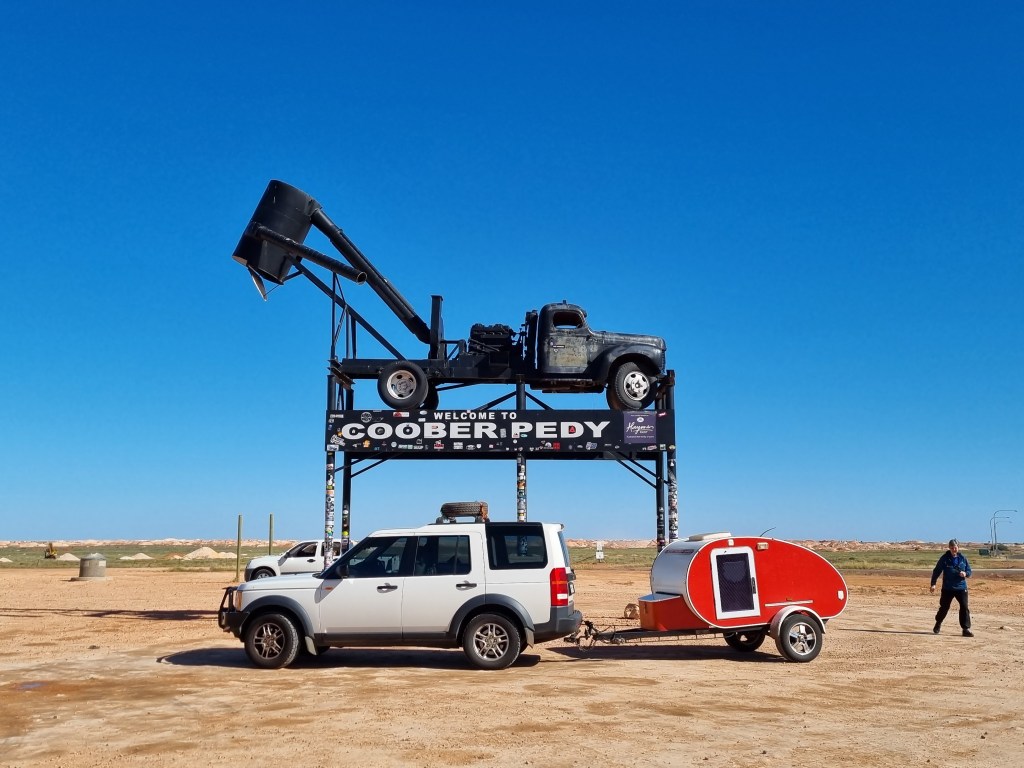
The handsome Discovery 3 pictured here belongs to Judy, who has generously agreed to tow a titchy “Teardrop” Van where I expect to languish in comfort whilst she sleeps close to the ground in a tent…sad really…
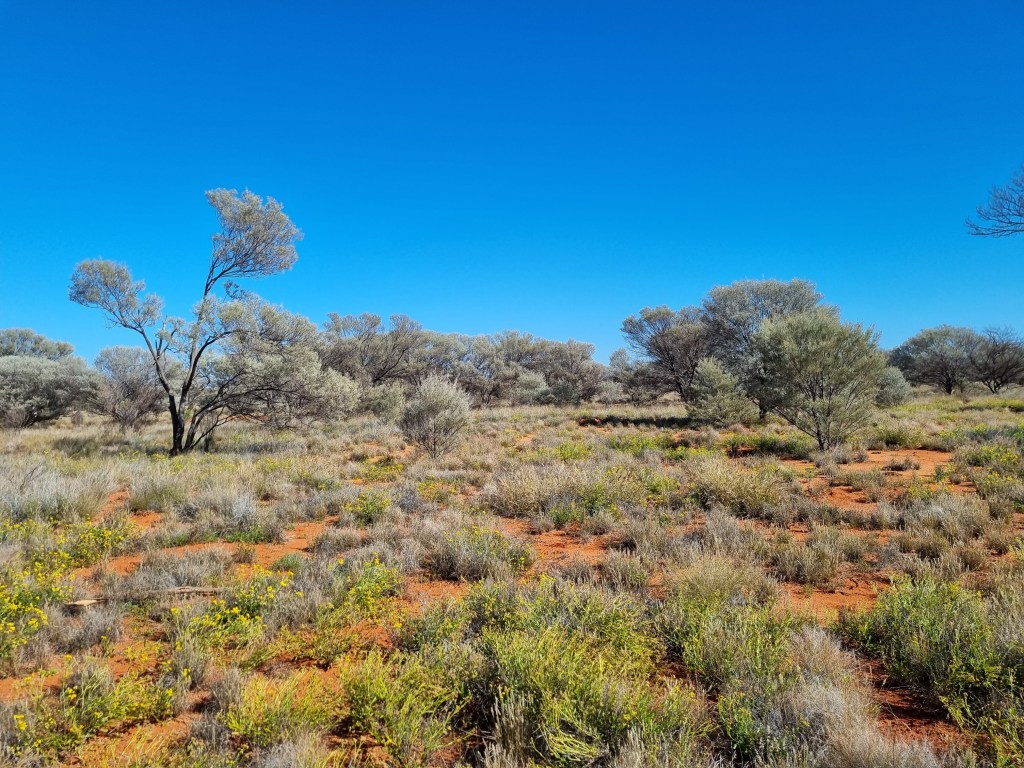
Soon after reaching the Northern Territory border, we move into the typical territory look with rich red soils and Mulga trees. The recent rains have led to a flush of wildflowers which will certainly provide carpets of gold in August and September. This sneak preview is a treat.
Further on we start to see Casuarinas (She Oaks) and red sand dunes. What a delight! Sadly we are not heading to Uluru this time around, but this is where these wonderful trees as well as Desert Poplars are in abundance. The drive to Uluru and Katajuta is therefore stunning.
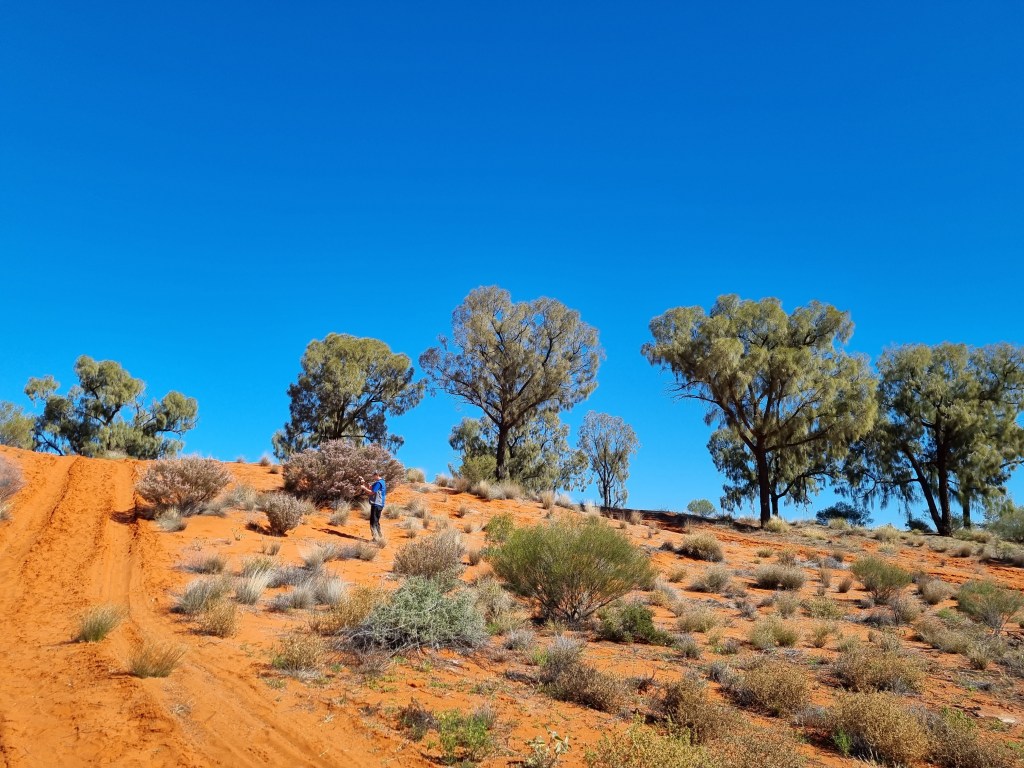
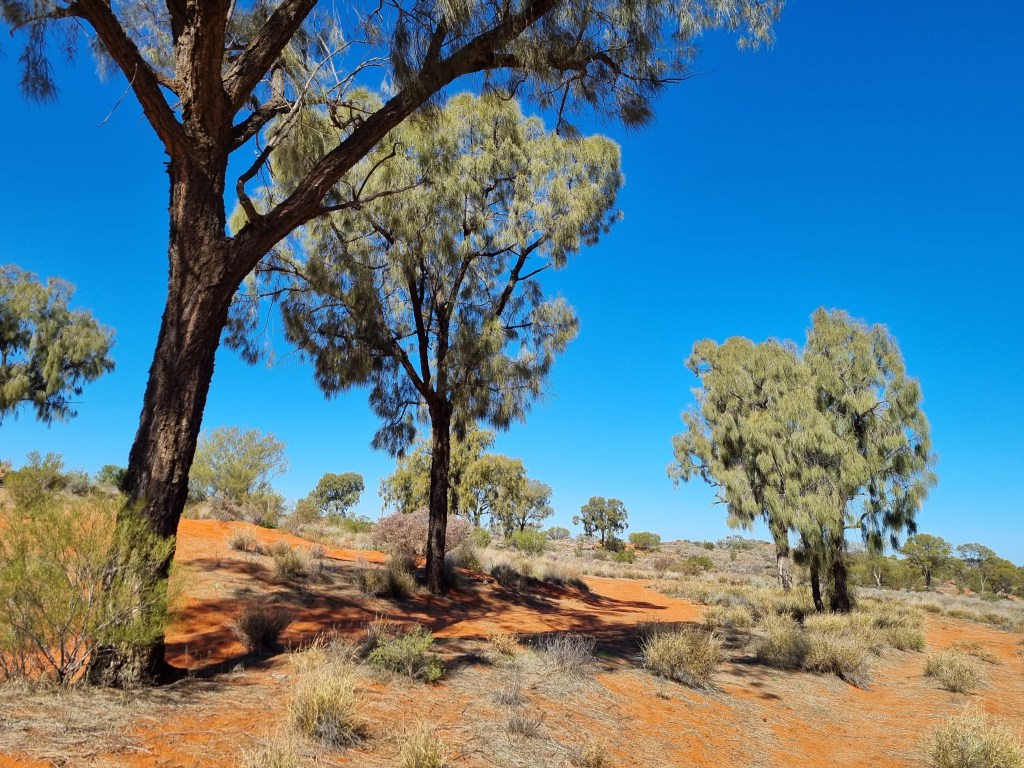
Having reach the Alice we are now reprovisioning for the next leg of our trip further North. The history of Alice Springs is fascinating as it was pivotal to the so called “greatest engineering feat of 19th century Australia”. At this time an ambitious plan was devised to build a telegraph line from Adelaide to Darwin following the path of McDouall Stuart the Explorer. It was completed in 1872 and later a further link to the Java-Darwin submarine telegraph line gave Australians the ability to communicate with Europe.
A repeater station for this service was constructed in Alice Springs in1871 and the town grew rapidly once alluvial gold was discovered at Altunga in the Eastern MacDonnells1887.
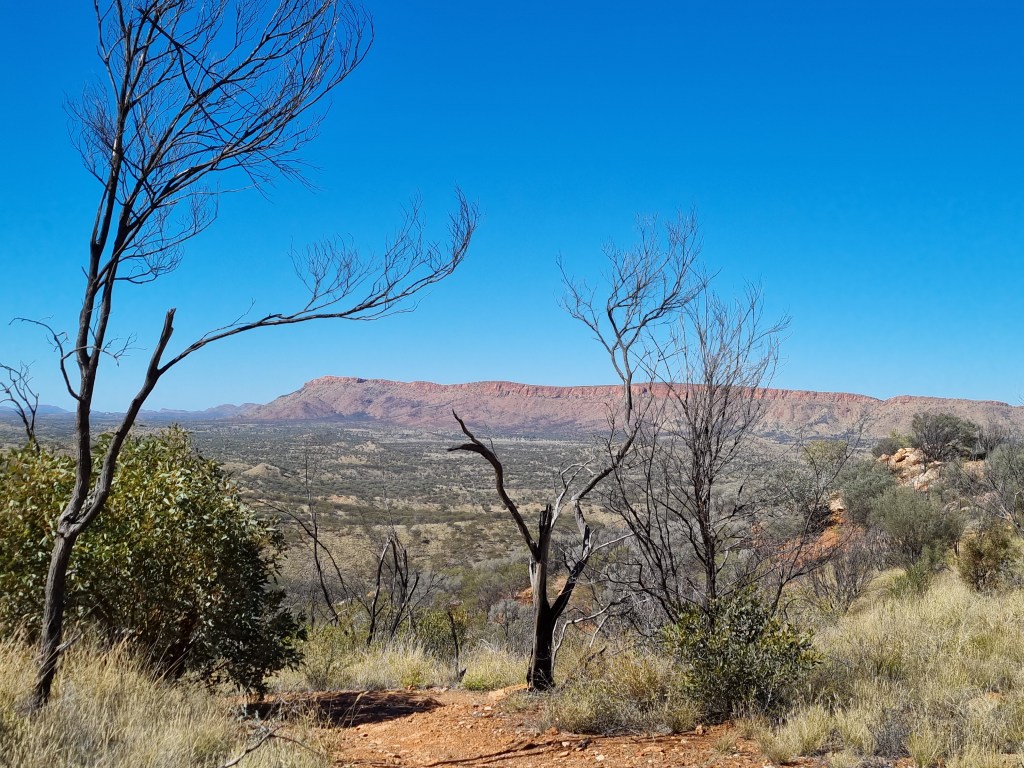
But today there is a need to engage in something resembling exercise so a picturesque walk to Hat Hill near Simpsons Gap is undertaken with much clicking of cameras. Quite apart from this great view looking towards Mt Gillen there is always much natural beauty to admire. And in this spirit, I give you the Bird of the Day, the Zebra Finch. They are normally found in great numbers near water, and so it was to be. We were delighted to see hundreds chattering and moving around us through the bushes and trees. These birds are quite small and have black stripes around their eye. The males sport a red face patch and mottled red under their wings to complement their beak of the same colour.
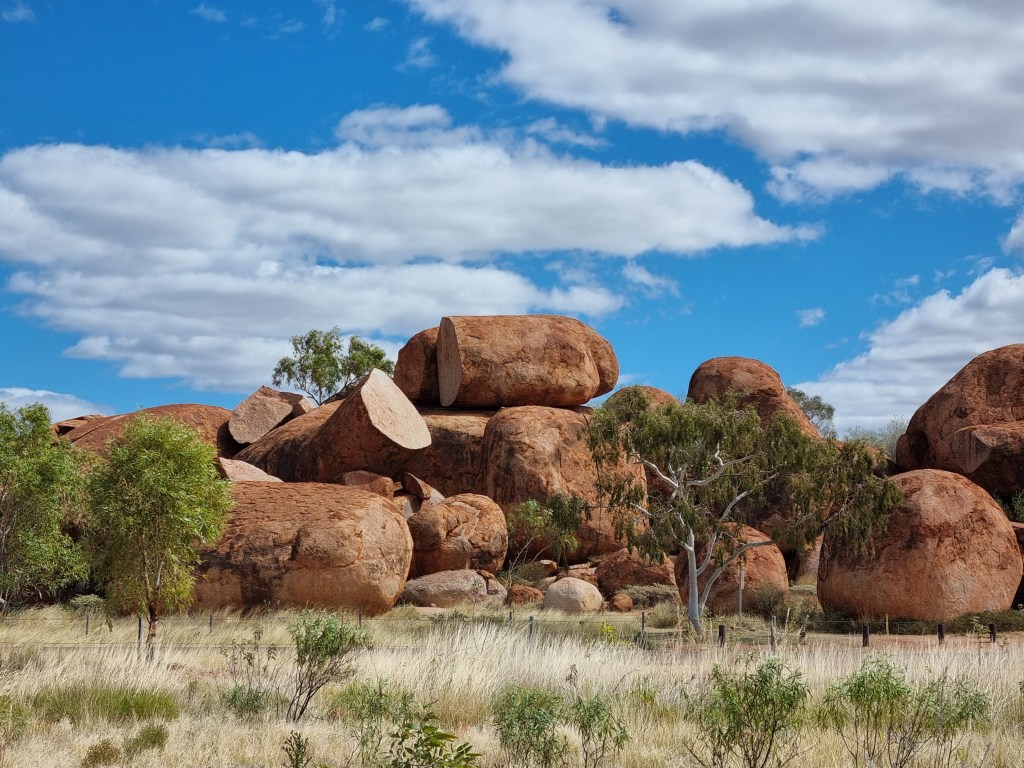
Heading Northward the next point of interest was the Devils Marbles, the remnants of granite outcrops, the bulk of which still lies underground. Kilometres of marbles, some teetering on top of others are scattered around and are quite stunning to behold.
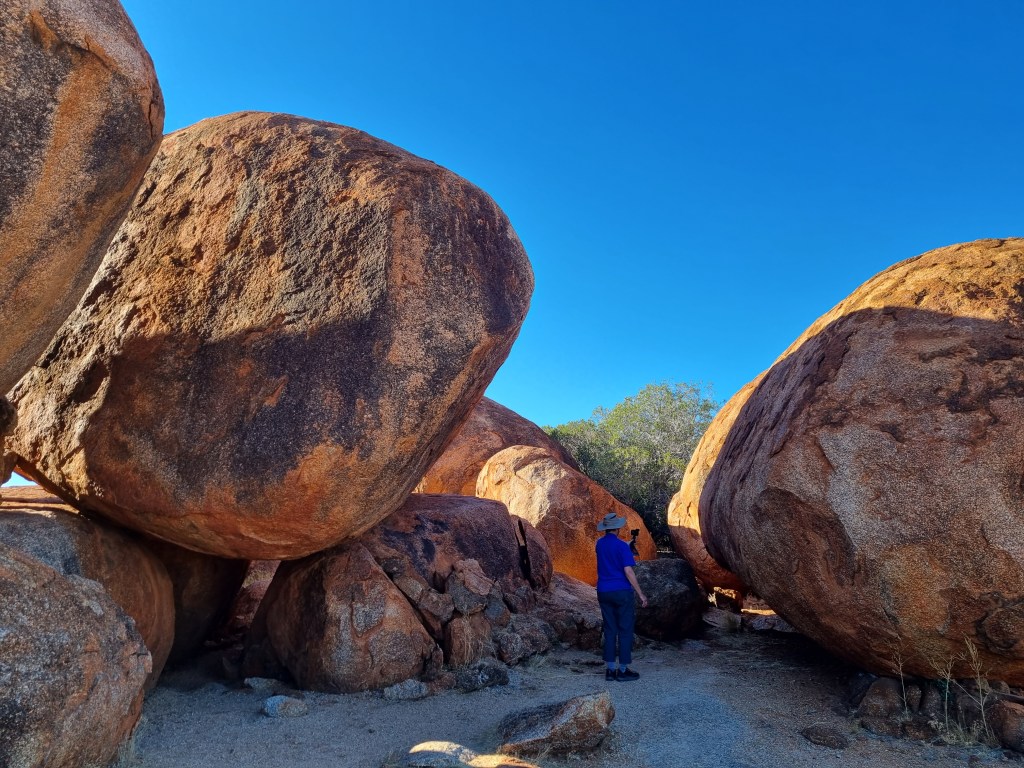
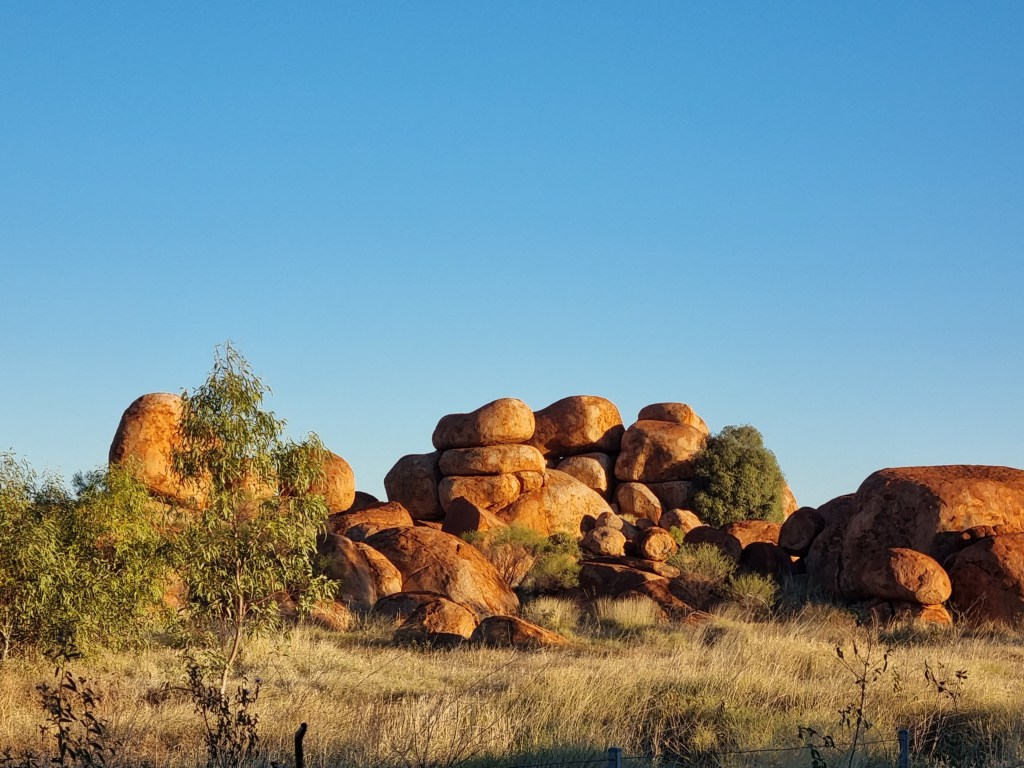
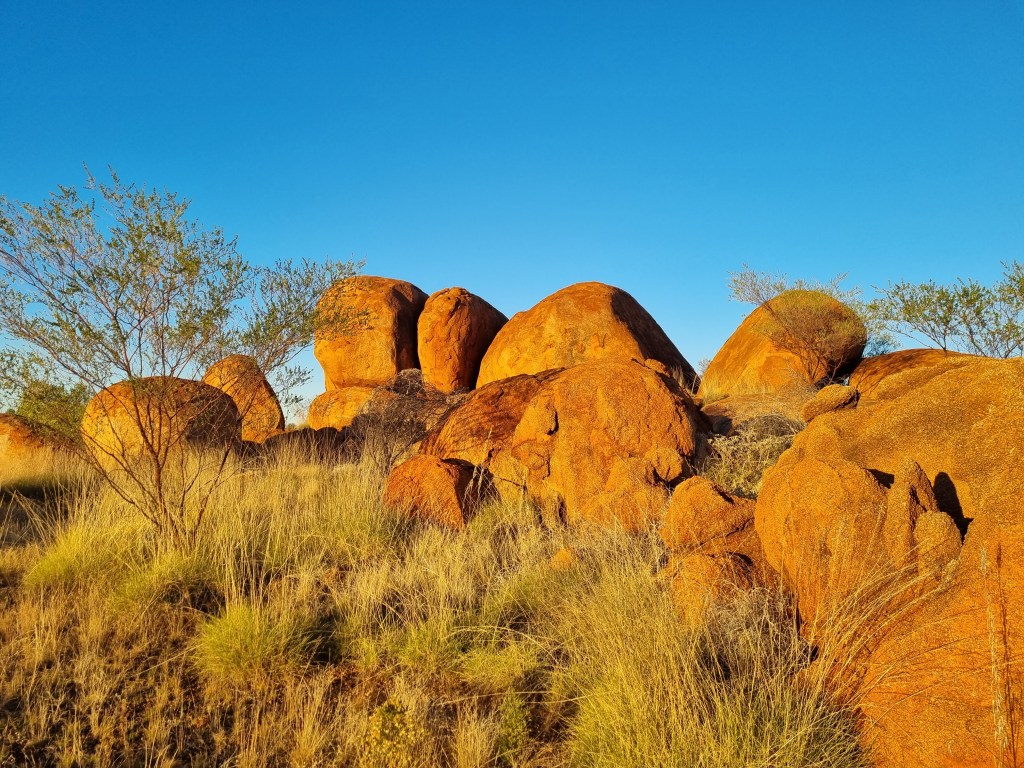
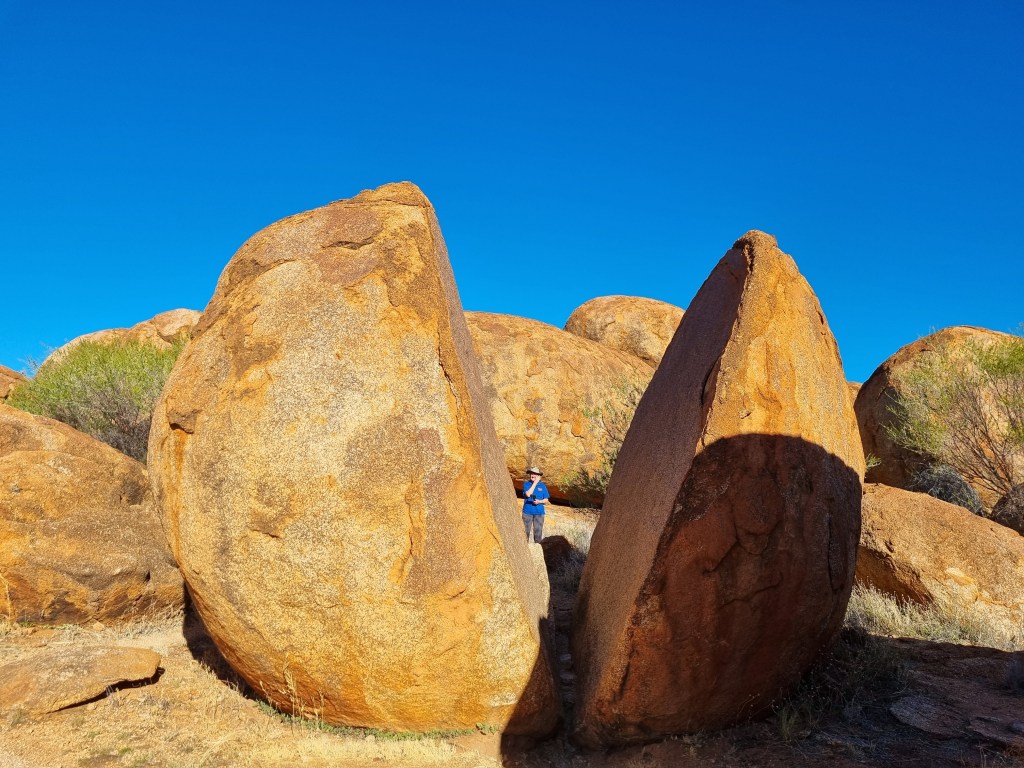
Sunset on the Devils Marbles was stunning, so we wandered around for quite some time. The next day, as we passed by Tennant Creek, termite mounds made their appearance. The vistas became crammed with thick fields of grasses, bushes and trees. A relief after so many hours of the rather spartan arid zones.
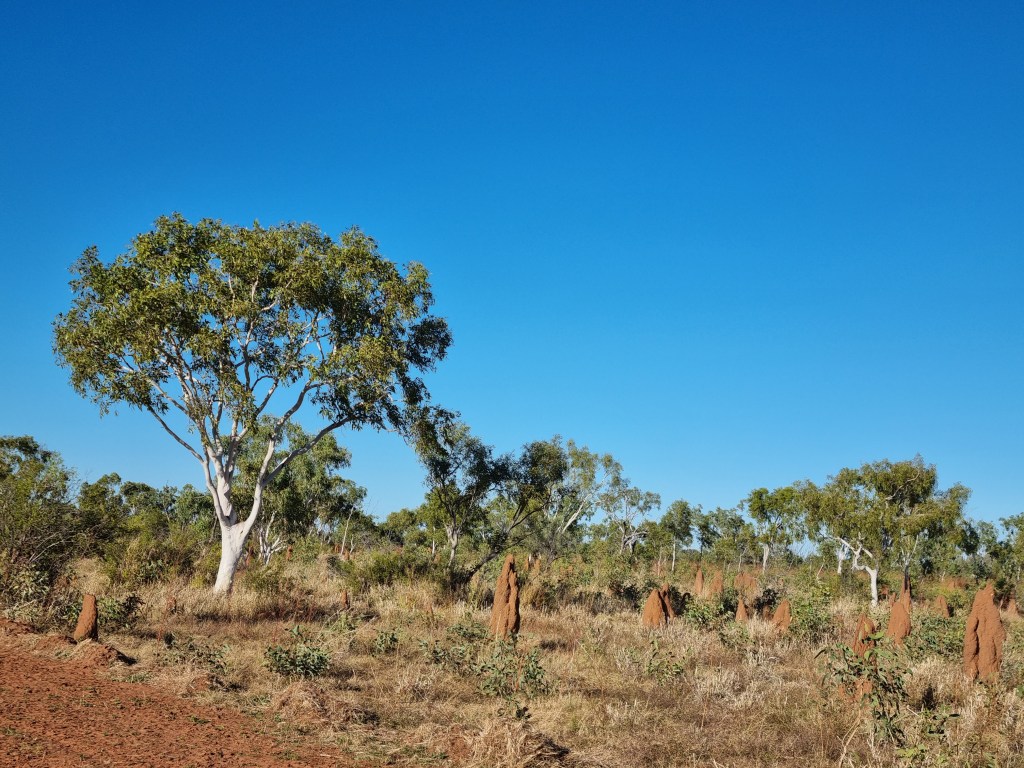
By tomorrow evening we should be situated in the Victoria River District and withing striking distance of Kununurra. Today we were delighted to see a large flock of Red-Tailed Black Cockatoos, and many groups of Cockatiels. There are lots of Birds of Prey gliding overhead too so food must be plentiful. No doubt recent rains have helped increase the population of their tucka.
A warm night and now we are on the road early to get to Timber Creek in the Victoria River District at a reasonable time given a particular camp spot is desired and we have some distance to cover before dark. I should be clear that we never travel these remote areas after dusk because of the wildlife that abounds. We need not have rushed though as mother nature ensured we were one of very few at that usually popular camping spot.
But first we headed to Katherine and turned West along the Victoria Highway to the Victoria River roadhouse and passed the tracks that provide entry to Gregory National Park. How I would love to be veering into this area as the vistas around here are terrific.
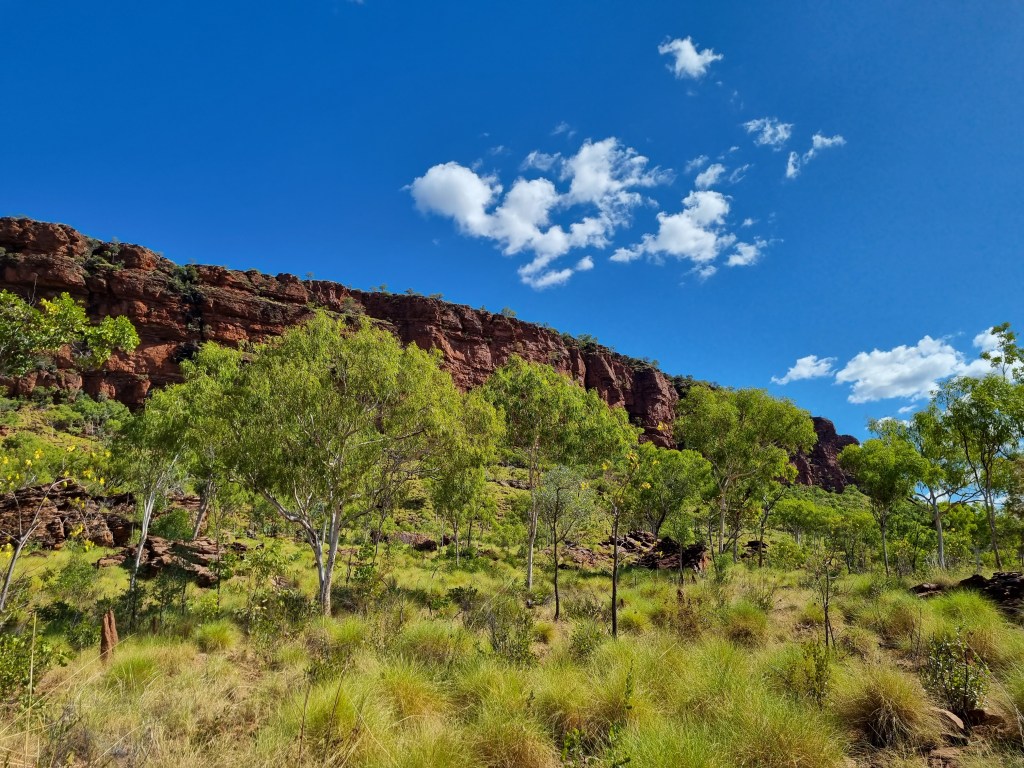
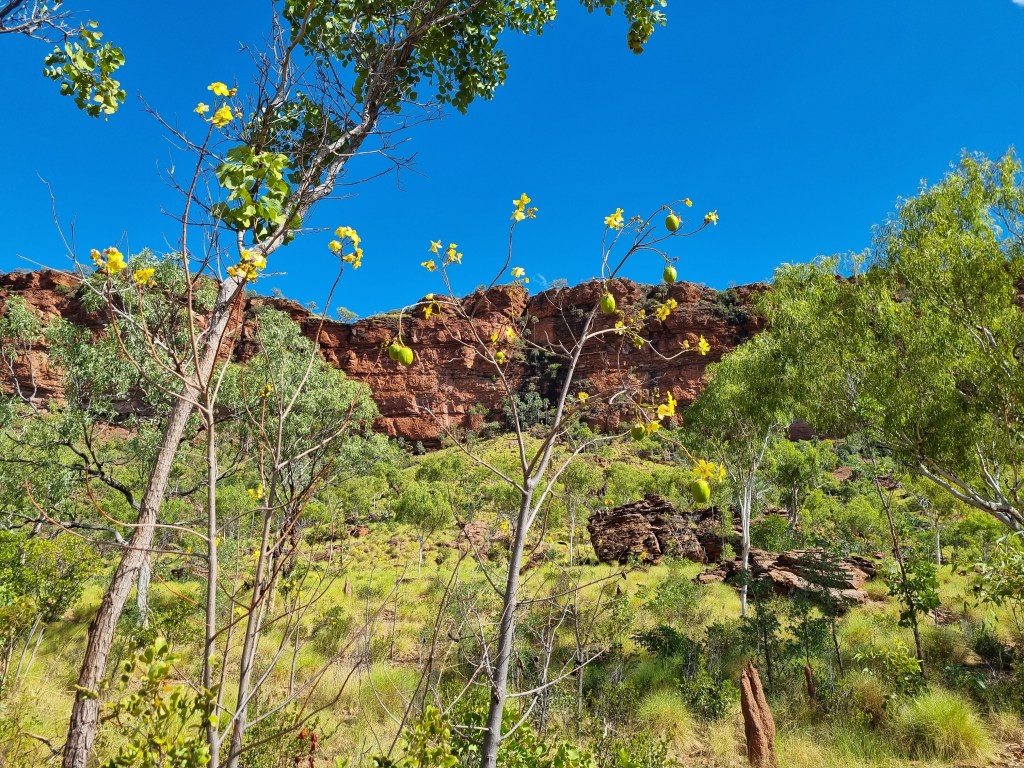
Masses of medium sized gums and spinifex populates this grassland, including pristine white ghost gums. We are also pleased to see vast areas of Kapok trees, some with fruit and a signature tree of Western Australia the Boab. Even one or two Palms…how delightful! By now it’s about 30deg and we arrive at Timber creek to camp.
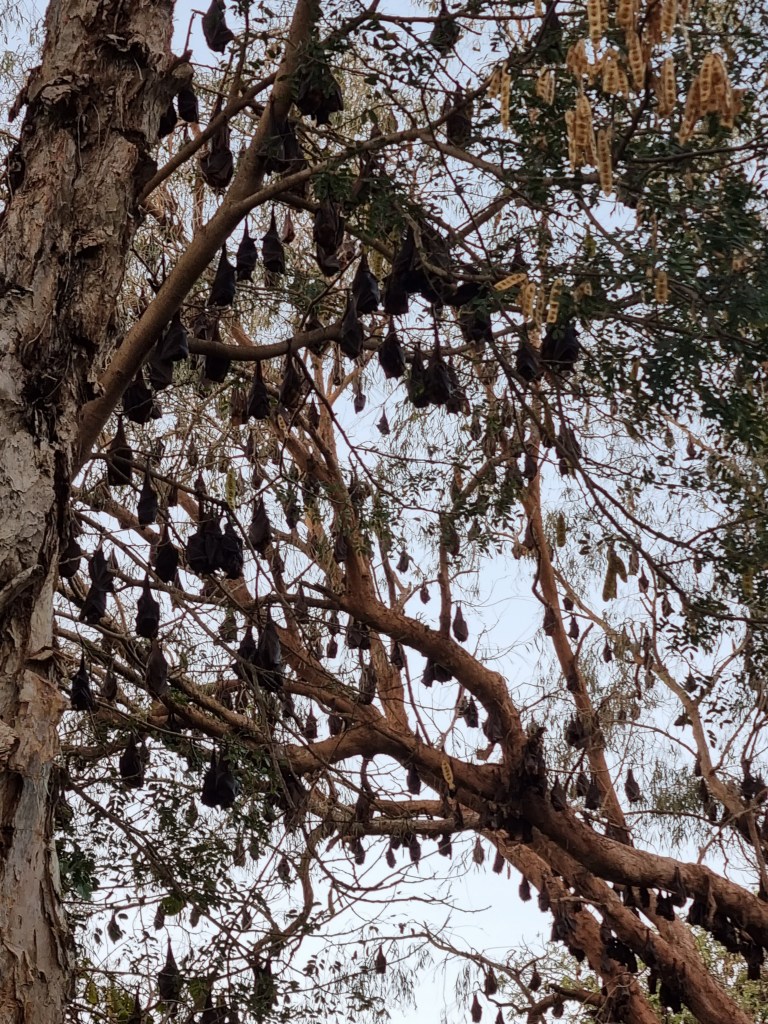
The grounds are nearly deserted, apart from the many thousands of Flying Foxes (Battus Battus) that have roosted in the campground trees. Interesting… but I can understand the dilemma for the owners of this campground. Bats don’t have our tidy habits and if you are not sheltered at dusk things can turn ugly. Personally, I don’t mind bats and we decide to stay (being eminent naturalists) and take plenty of precautions. An early tea before dusk, a choice to sleep in the van and to ensure every bit of camping gear is hidden. Sure, enough as dusk arrives, we have the mass fly over and rain of you know what…but we are under cover…. well not quite Judy looks to have a “blob” in her hair. Makes me want a really good shower right now!!! and I figure that if I ignore the uriniferous smell the breezes should clear things away (is this wishful thinking?).
Tomorrow, we have a short distance to Kununurra and a chance to clean up and regroup ready for Purnululu. A fellow who we chatted with last night decided he would give the Buchanan track (our aborted plan) a go today and he hasn’t turned up yet…tricky as the road at this end says part of it is “closed”. He is probably axil deep in mud right now.
I should mention our Bird of the day which is a Varied Triller. A first for us and a beauty only seen in these far Northern zones. A medium sized bird with black and white wings, rufous colouring under the wing and striations on its creamy front. The heavy white eyebrow is a giveaway. The sweet trill is most pleasing to the ear.
Arriving at Kununurra we meandered down to the waterfront of our camping area to find a “snapper” dozing. Now you would understand we are well within the “do not dangle your feet in the water” zone. Nasty things can and do happen. This crocodile happened to be of the freshwater variety and in my eyes somewhat harmless to me…now if I were a dog?

My memories go back to a time when we were travelling with friends South from the Mitchell plateau in the far North of WA. A local station owner said we would be most welcome to visit his families favourite swimming area and off we headed with his mud map. What a spectacular place! It was very very hot so once we got ourselves out of a couple of sand bogs we headed straight for the billabong, swimming gleefully. After a while we noticed snouts wandering up and down with us. A couple of our team were utterly horrified and made a speedy beeline to the shore. The more stalwart of us thought it would most likely be the smaller freshwater crocs enjoying our company so kept swimming. After all the property owner did call his billabong Crocodile Pool… Following tea, we shone the torch into the water and sure enough it was loaded with shining eyes.
Week 2. It’s now on to Purnululu (the Bungle Bungles) the highlight of this trip. The first time we visited this area was about 35 years ago, a time when we folk and the ranger were the only white living souls around. It took 5 hours to drive in on a very challenging road, whereas today we are gifted a short 2 hour trip for the 50kms, albeit there are still corrugations by the dray load, creek crossings (thanks to that last cyclone) and plenty of other rough patches. So, much improved, although the wrong place for vans that are not built for the rough and tumble as attested to by the one pulled over in the scrub with a broken axle. On the way out we see another broken down van on the side of the track.
Purnululu is an amazing place as its foundations were laid down 360 million years ago. Over time deposits of sandstone and conglomerate uplifted and were then incised by flood waters. The resulting deep gorges are in evidence. The thing that confronts the senses are the huge and imposing escarpments and rocky outcrops that rise to 200 metres above the surrounding plains.
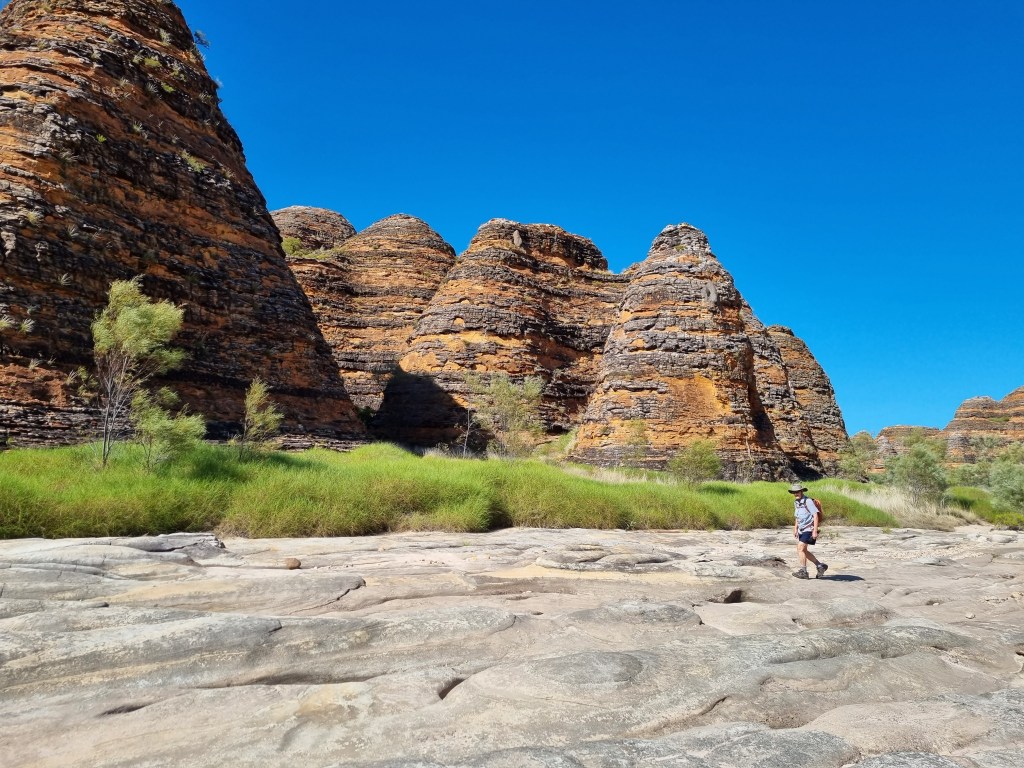
Our first target is Picaninny Gorge famous for its awesome domes. As you drive there you pass by the escarpment and then later see the domes in the distance. These domes are spread vastly so we will only see a small portion in our travels today. That will be enough to provide you with a glimpse of this stunning area.
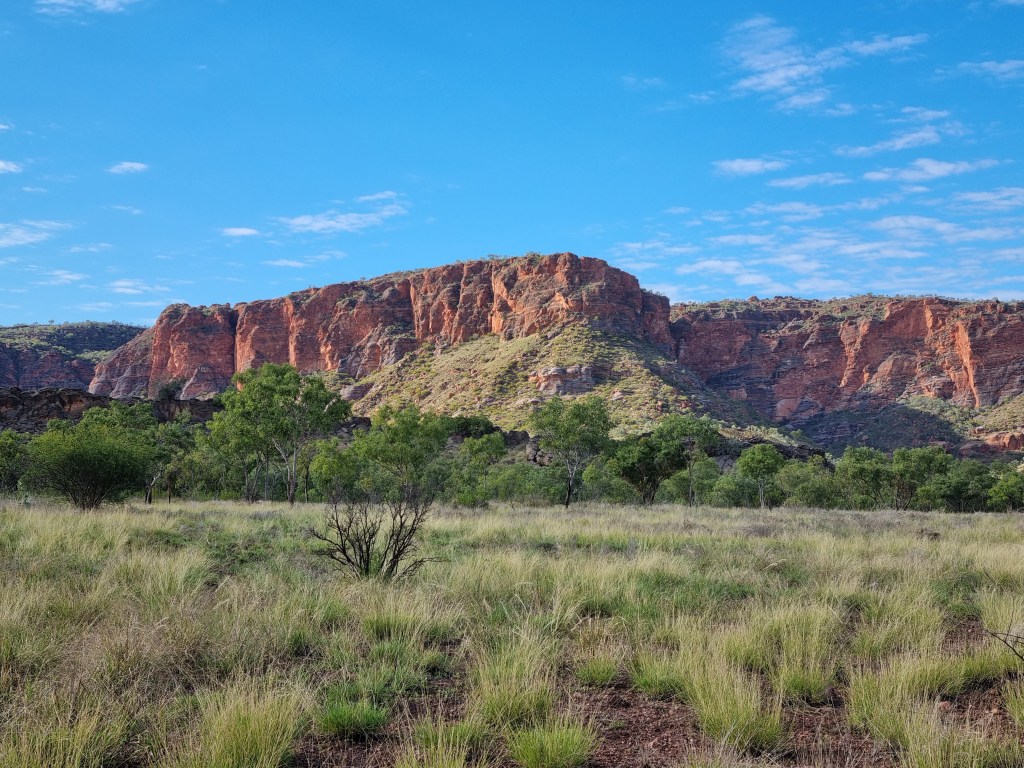
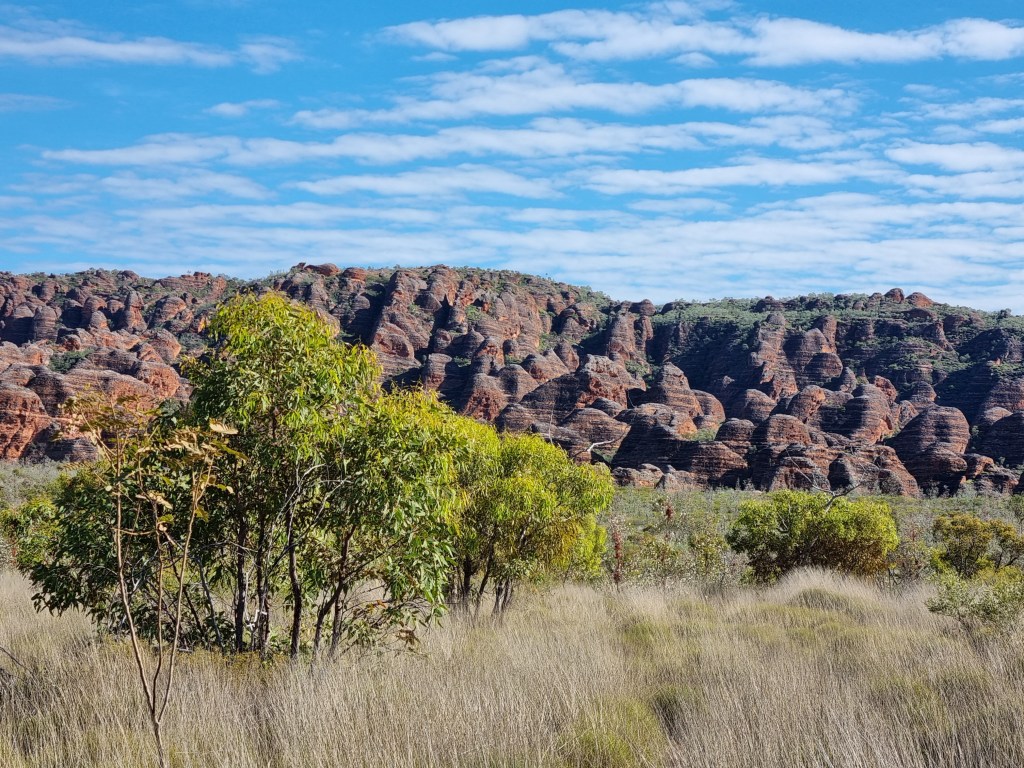
For interest these domes are very fragile and are encased in a protective skin or red iron oxide and the grey cyanobacteria bands
Heading down the creek we pass by the domes to a lookout.

Sometime later we turn onto the track to the Cathedral Gorge. Cliffs guide us down into this area until the target area is reached.
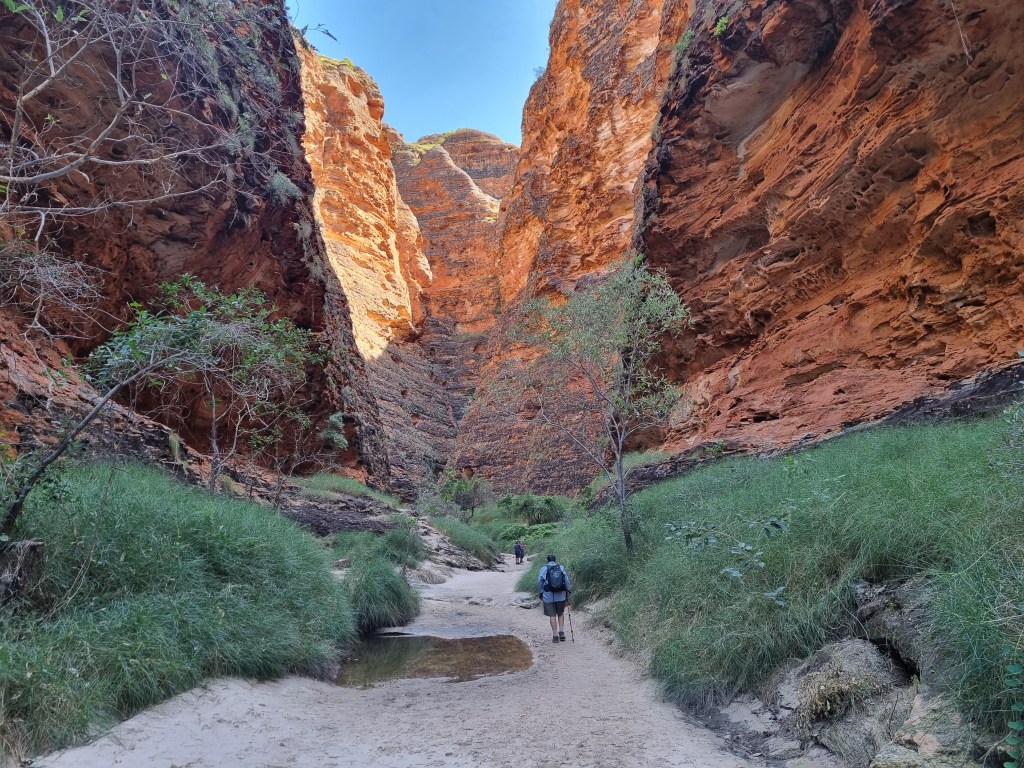
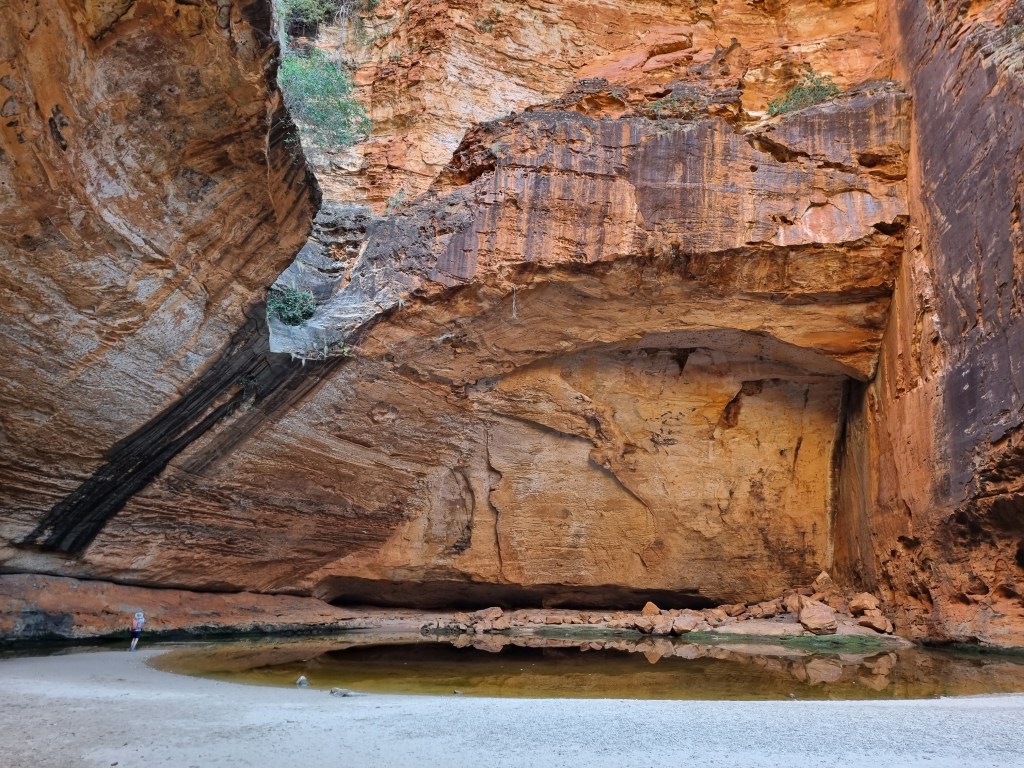
You will see Judy as a speck on the left hand side. Retracing our steps there are still significant vistas to be seen.
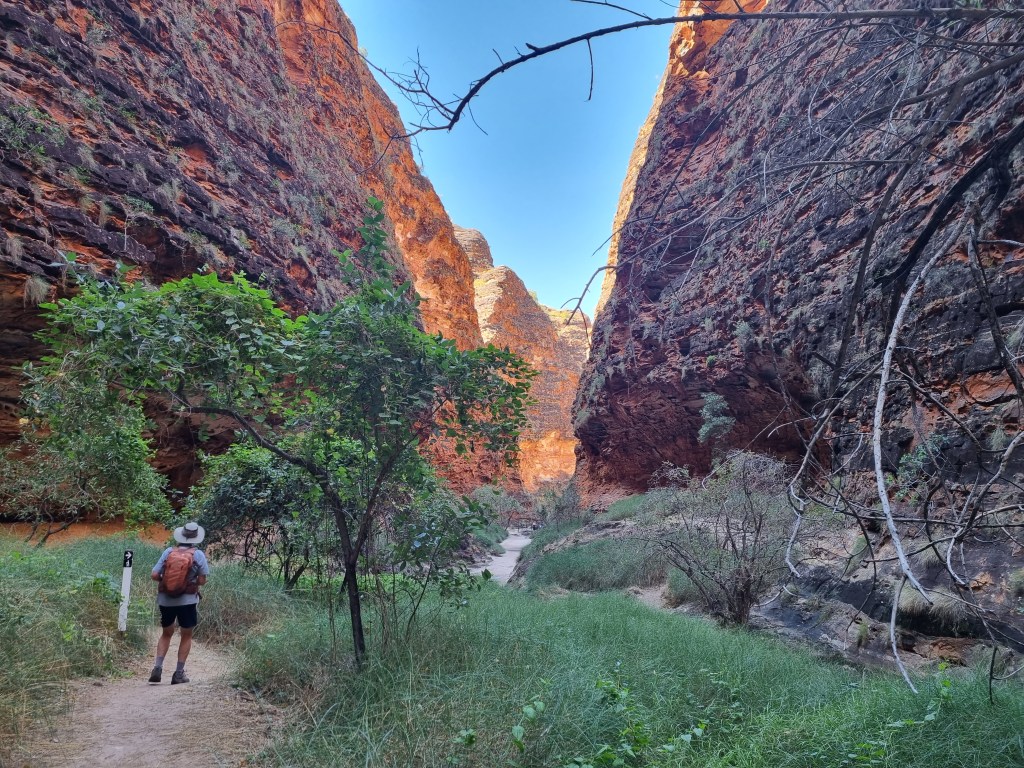
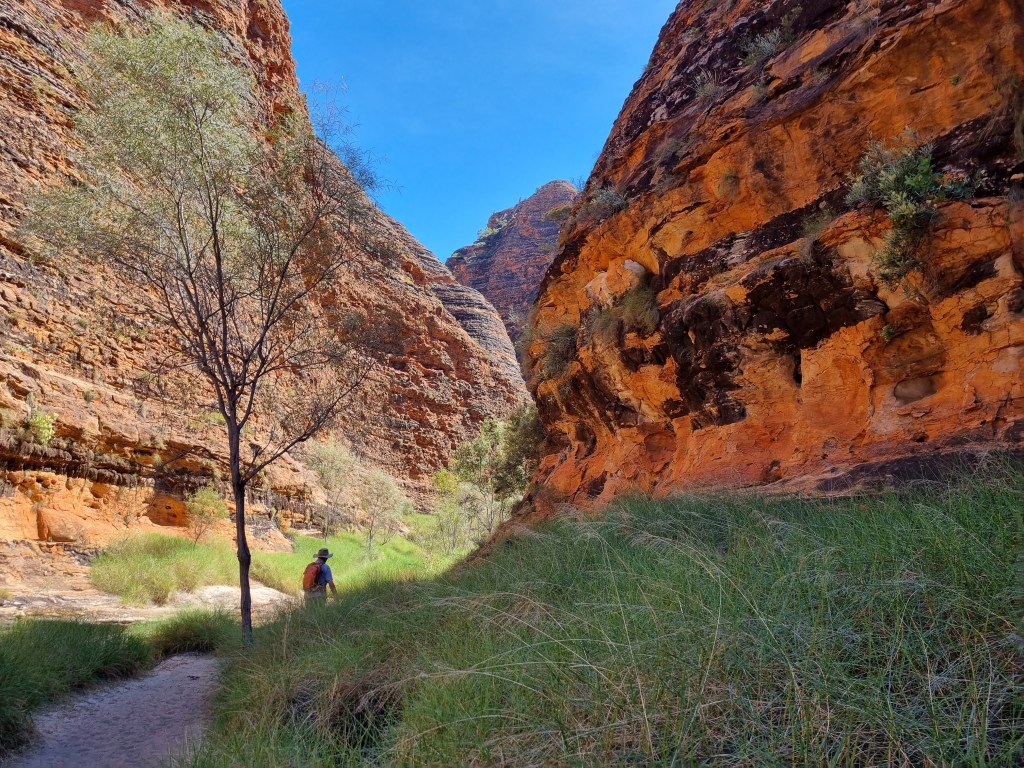
The next day we plan to visit Echidna Chasm which is in the more Northly section of the escarpment whilst the domes are more Southerly. Now if you reckon Simpsons Gap in the NT is awesome wait till you visit this mammoth chasm. Its gobsmacking! We are delighted to see so many baby Spinifex plants which could be attributed to the huge rain falls recently. The rock faces you start to see close are clearly conglomerate and I gather several hundreds of metres thick here.

As you walk down the creek bed and paths you pass lots of Livistona Palms and are confronted with the annoying chorus of many Silver Crowned Frair Birds. These are my Bird of the Day simply because they so wanted to tell us we are in their turf. Jolly raucous!!
Getting closer to the chasm the cliffs pull in and then we enter a long chasm and after some distance arrive at an amphitheatre which, as its near midday lights boldly soon after we enter it. On the right picture you can see where Judy moves from the chasm into the amphitheatre. But when it lights it’s far too bright to take any pictures until we move through past it and look back. The very end of this huge chasm ends in a rock fall which may be interesting on the other side, but which I have no intention of scrambling over…leave that to other more adventurous folk.
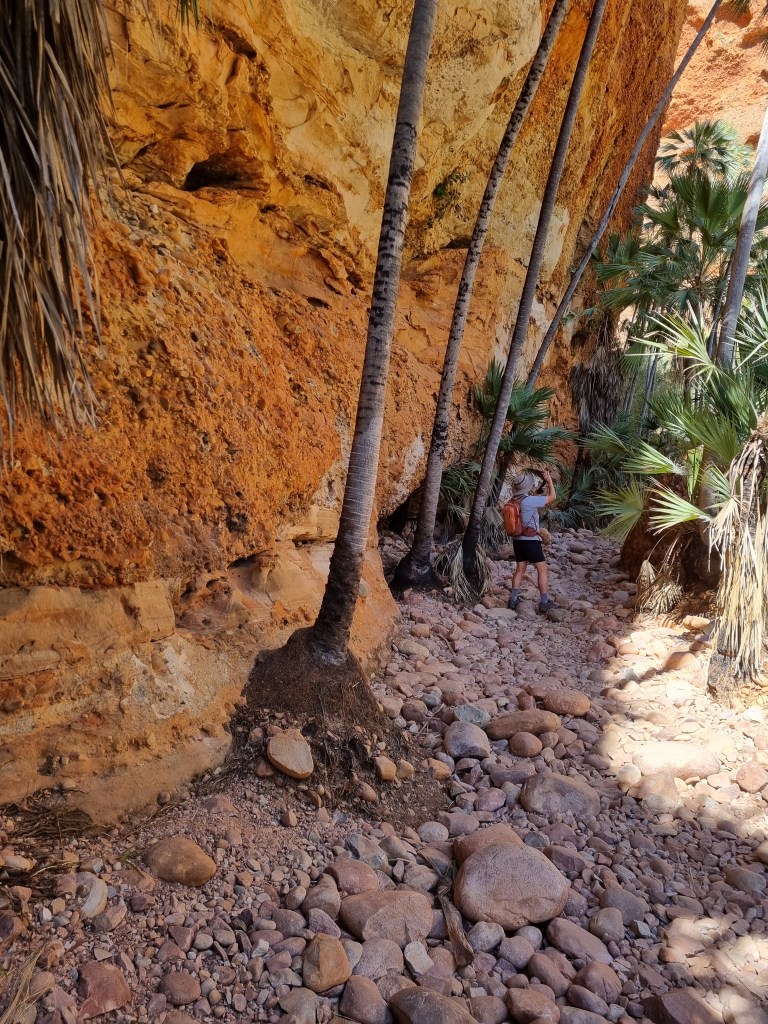
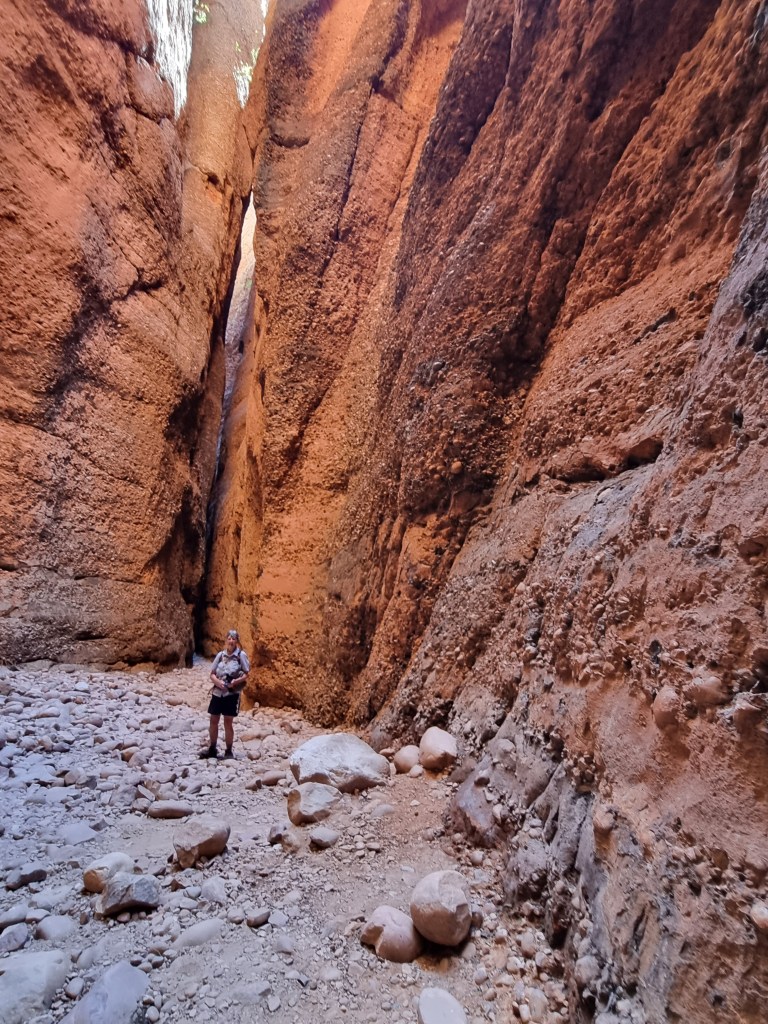
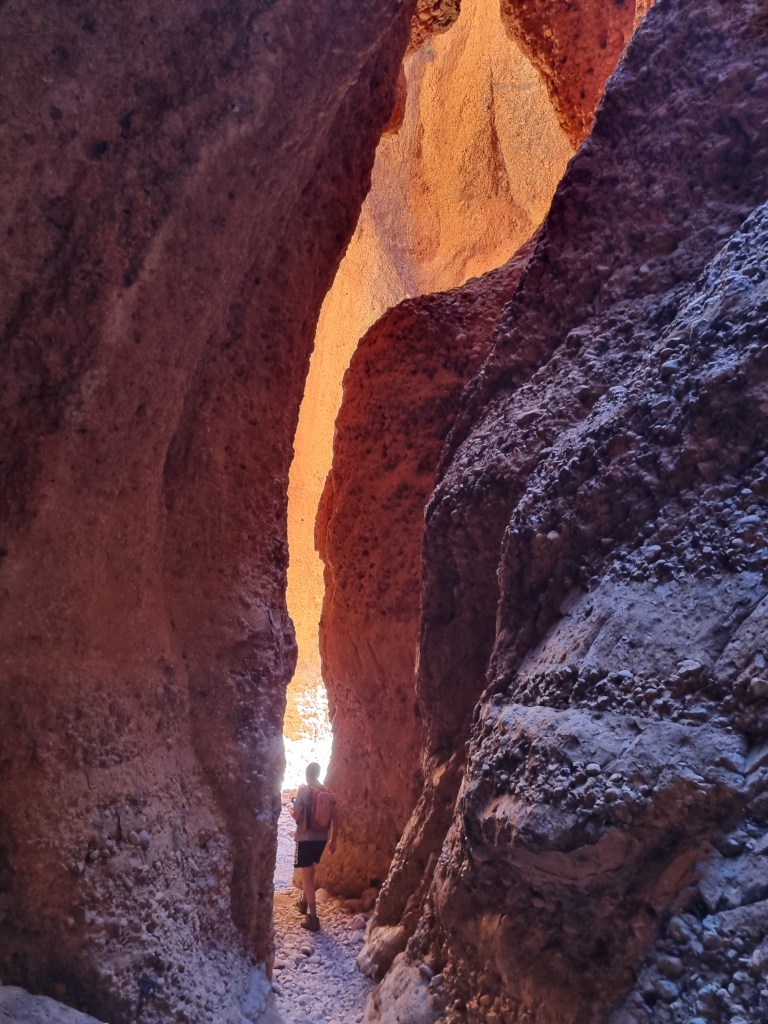
As we reverse our steps the sun still has the effect of illuminating the many cliffs around us. Moving back to the creek bed to head out we reckon it’s time for a well-earned coffee.

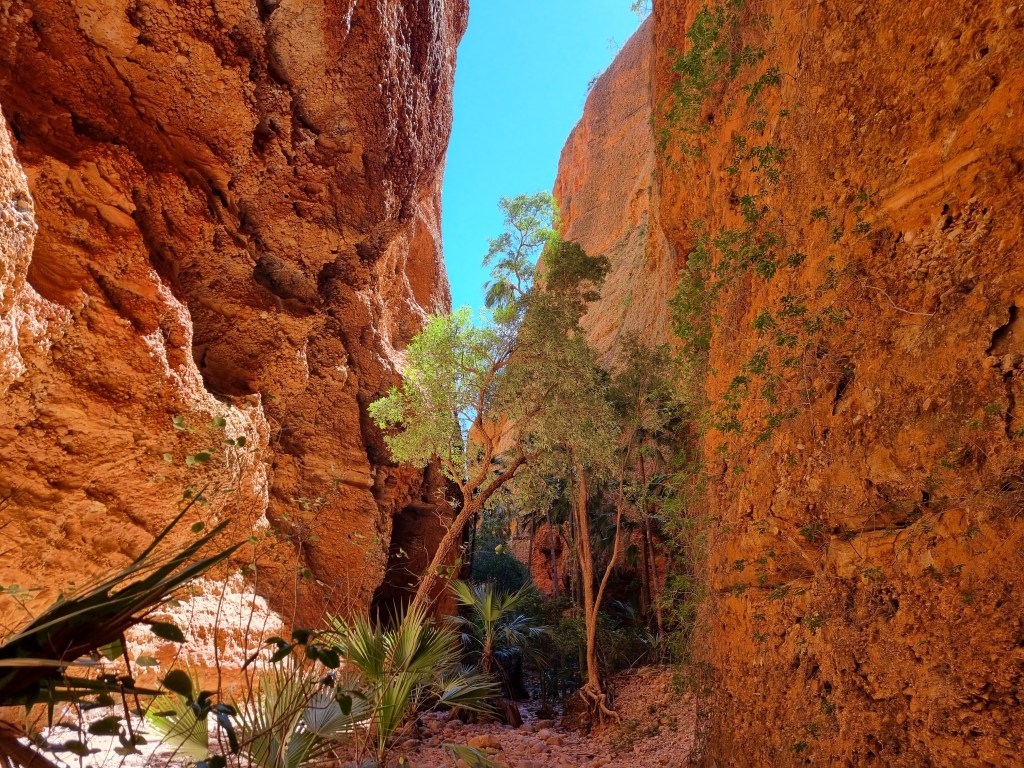
Driving back to camp one cannot but be struck by the imposing escarpments that accompany us all the way to camp and beyond. Its been a beaut day and we look forward to tomorrow, but first its time to freshen up. Now of course the only luxury that exists here in the camp ground is a pit loo (that’s good). There is also non potable water that will be useful to compliment the 40 litres we brought with us. A freshen up in this situation is a bowl of cold water and a washer…go to it!
Our next morning presents in a cloudy way. But that has done little to reduce the cool temperatures overnight …and here I must confess to an enormous oversight on our part. Being so very warm in Kununurra we assumed we would need only our light weight sleeping bag and minimal clothes. I have never ever made such a bad mistake before as the evenings and night have been quite cold. Inevitably this has meant we have been layering with every piece of clothing available to keep warm in the evening and night. In this we have been largely unsuccessful so have had to sleep chilled. I cannot wait to get back to Kununurra and our cold weather gear. Clouds are coming in and there is a pretty sunset to be appreciated.

The clouds cleared overnight so we plan to head back to the Echidna Chasm area for a couple of extra walks. These do no more that demonstrate the majesty of the huge escarpment that is visible everywhere we go.
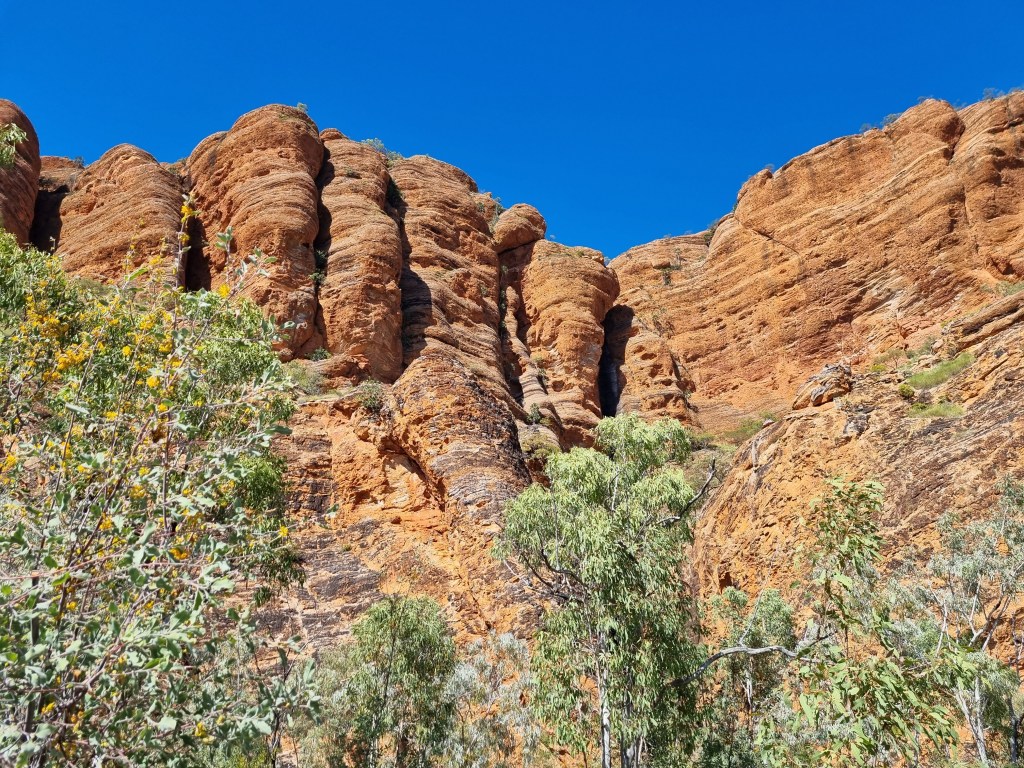
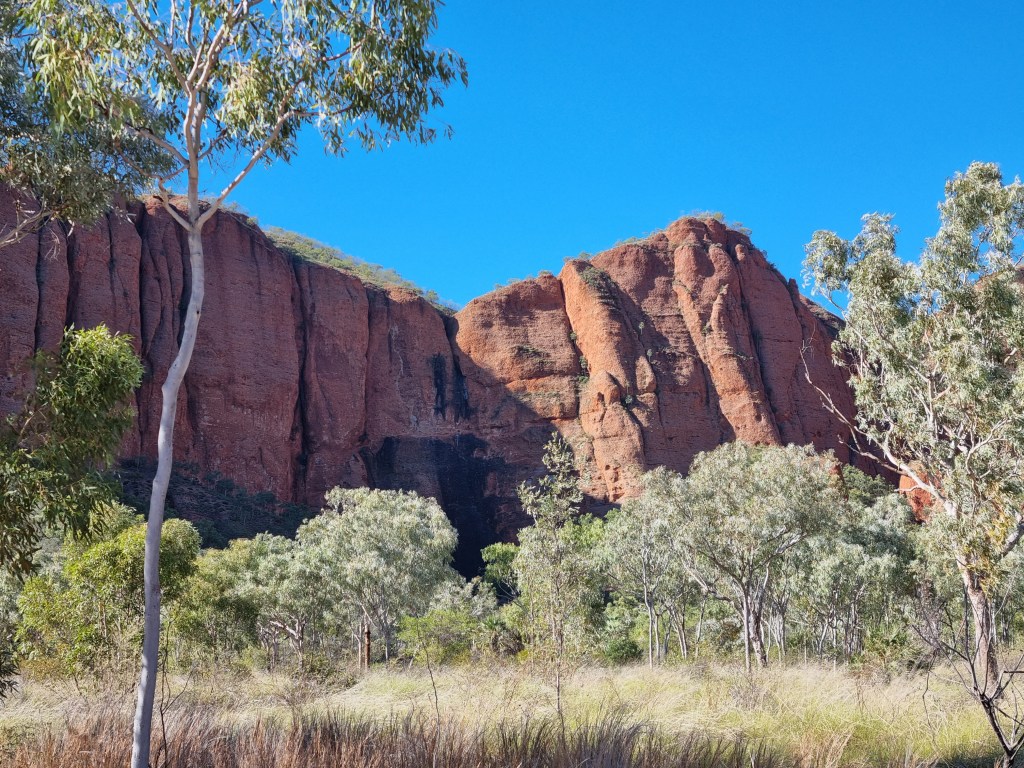
Wildflowers abound including red and yellow Grevilleas, pendulous Wattles, Pussy tails and lots of other beauties. The next day amongst all this delightful vegetation we plan a hugely significant walk, as we wish to revisit Phantom’s cave (our name) last seen some 35 years ago.
There is unique history here for us personally as our friends and a single ranger were the only white people in the Bungle Bungles then. It had not long been opened and we were keen to see it. He came rushing over to us when we arrived and said he had discovered something amazing and gave us a mud map. This we followed the next day and after quite some time, and lots of boulder scrambling were thrilled to see such a beautiful sight…which we called Phantoms cave. It was more like a cathedral really with an inwardly veering cliffs towards the cave. On the ground were hundreds of baby palms and the area felt pristine and sacred. Be assured we were very careful to traverse well away from the palms to enter the cave. Now, at last we have the chance to revisit this special place, which we captured then on Super 8. This has since been digitised and we watched it before we left for this trip.
The walk begins with a spinifex corridor until we hit the creek bed we must follow.
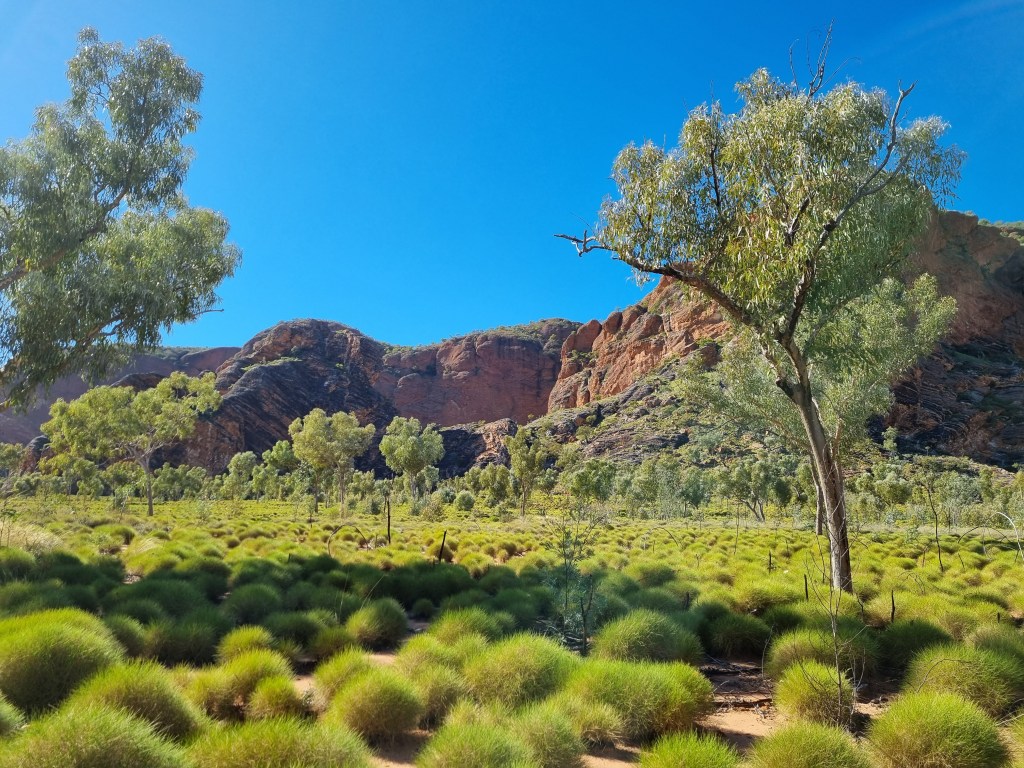
As one gets closer there are the usual magnificent cliffs to admire and livistona palm trees to guide us in. The spinifex is just stunning this year..
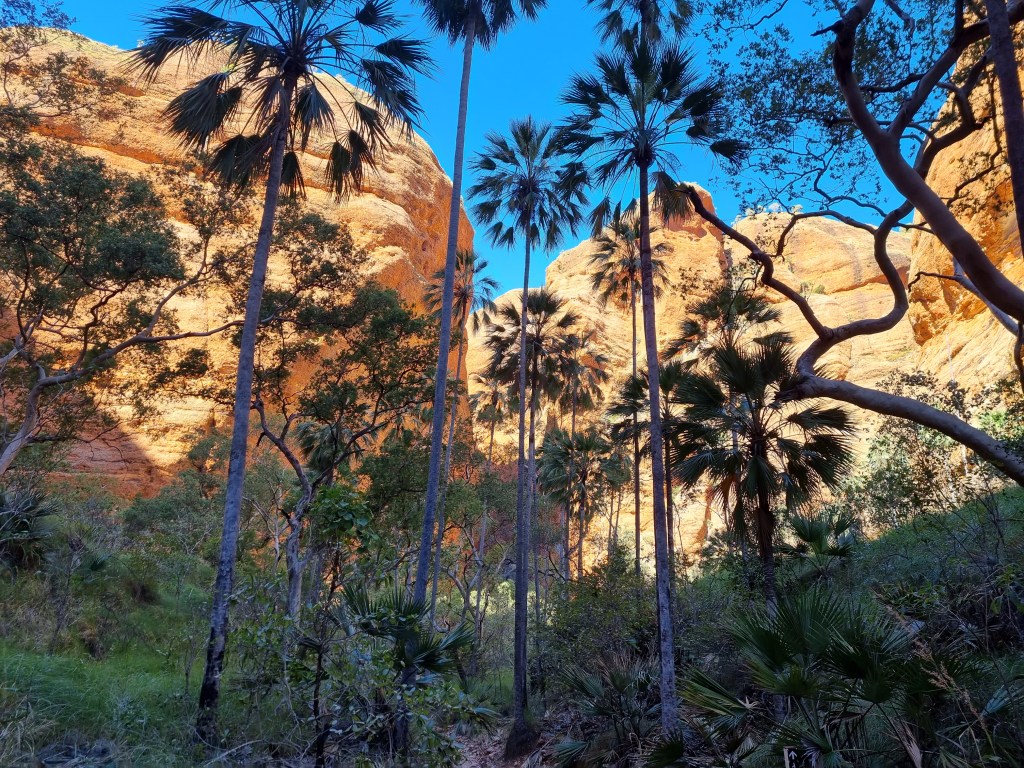
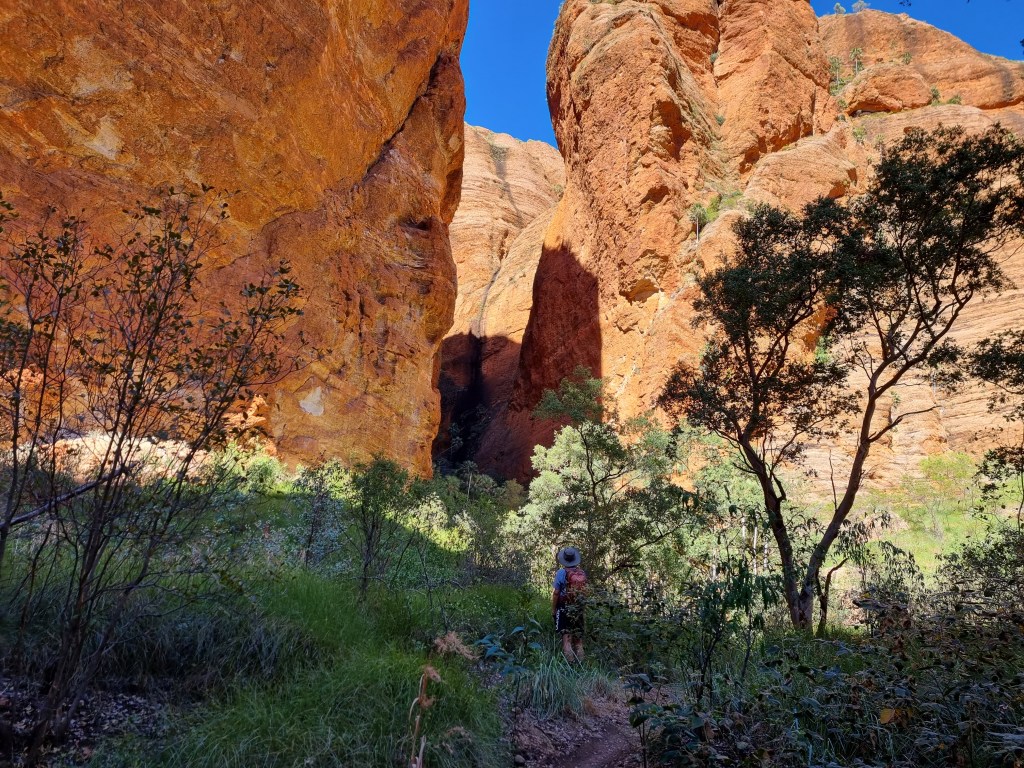
By no means is this a dawdle. The walk is graded at the highest level for Purnululu to encourage only those willing to clamber up, down big boulders to make the effort. Regardless we have no choice as this is a hugely significant personal space for us.
So after pulling each other up and down boulders for some time we found the track getting easier, and fortunately the last few really big boulders that we clambered up with great effort many decades ago now sport ladders.

Now I get that this may not seem much to you but its just so good to see this place again. The sad thing is the valley floor was full of these mini palms back then and few remain now. They have probably drowned over time. One can no longer walk into the cave.
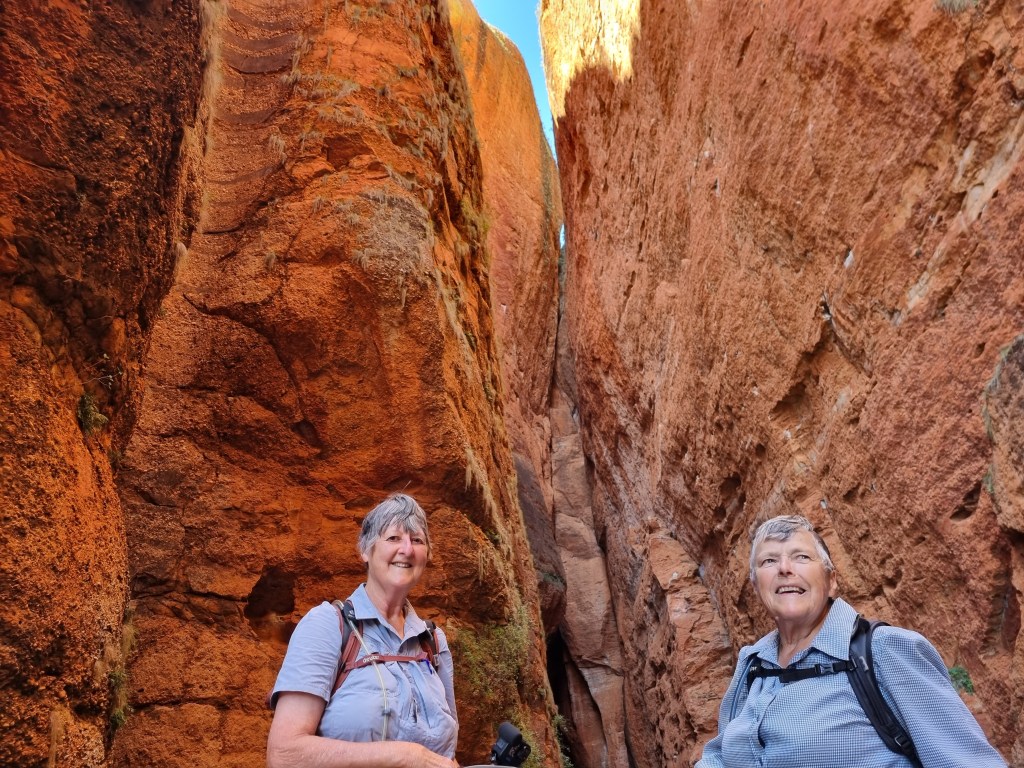
This, Joy, is evidence that we reached the now named Mini Palms. It still feels like Phantom’s cave to me.
Another glorious sunset and our goal for the next day is to head back to Picaninny Gorge to walk down to WhipSnake Gorge. What we did not realise when we wandered down the creekbed decades ago was that it ended in a huge amphitheatre. Actually, it’s somewhat like Cathedral Gorge a couple of days ago.
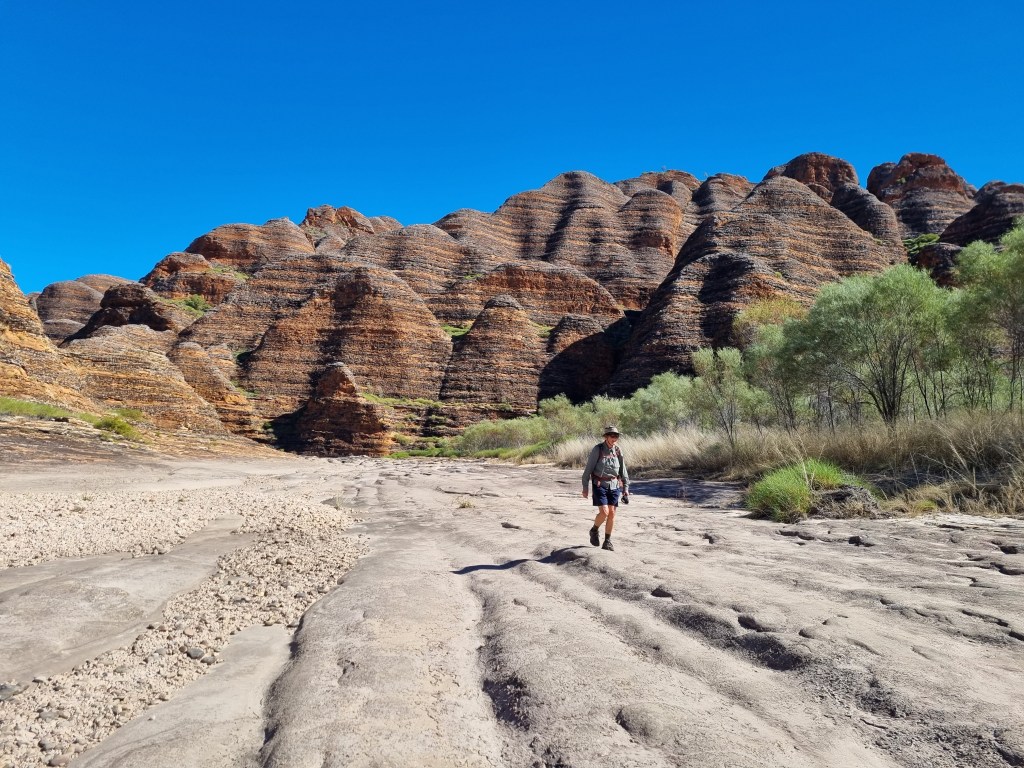
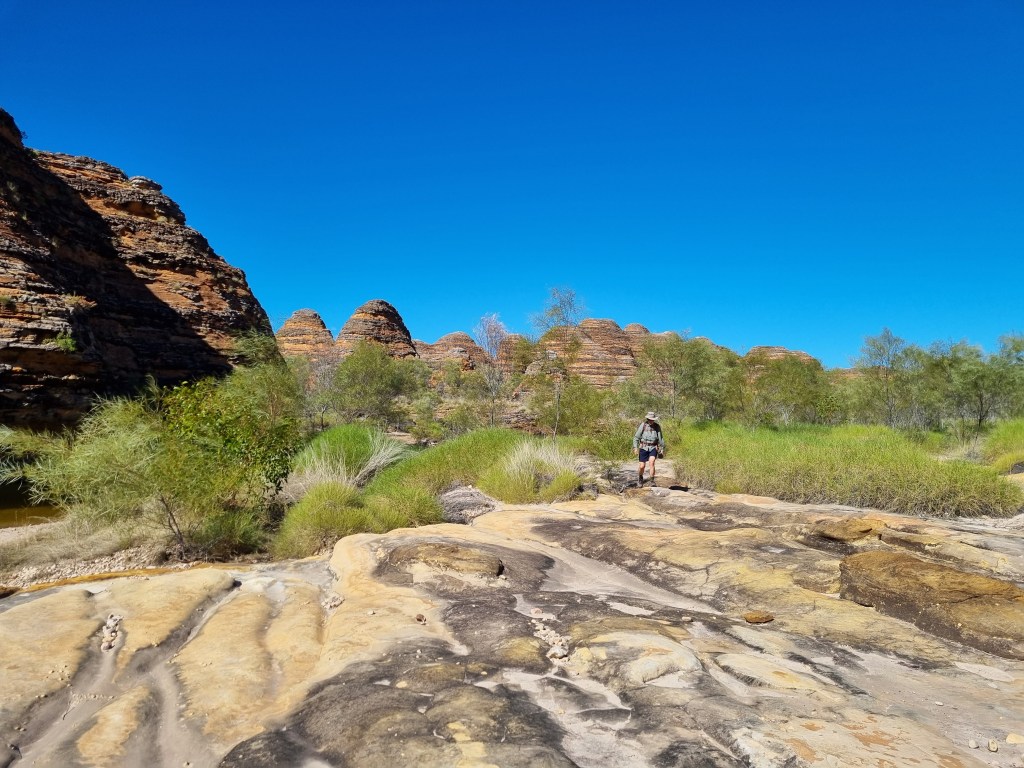
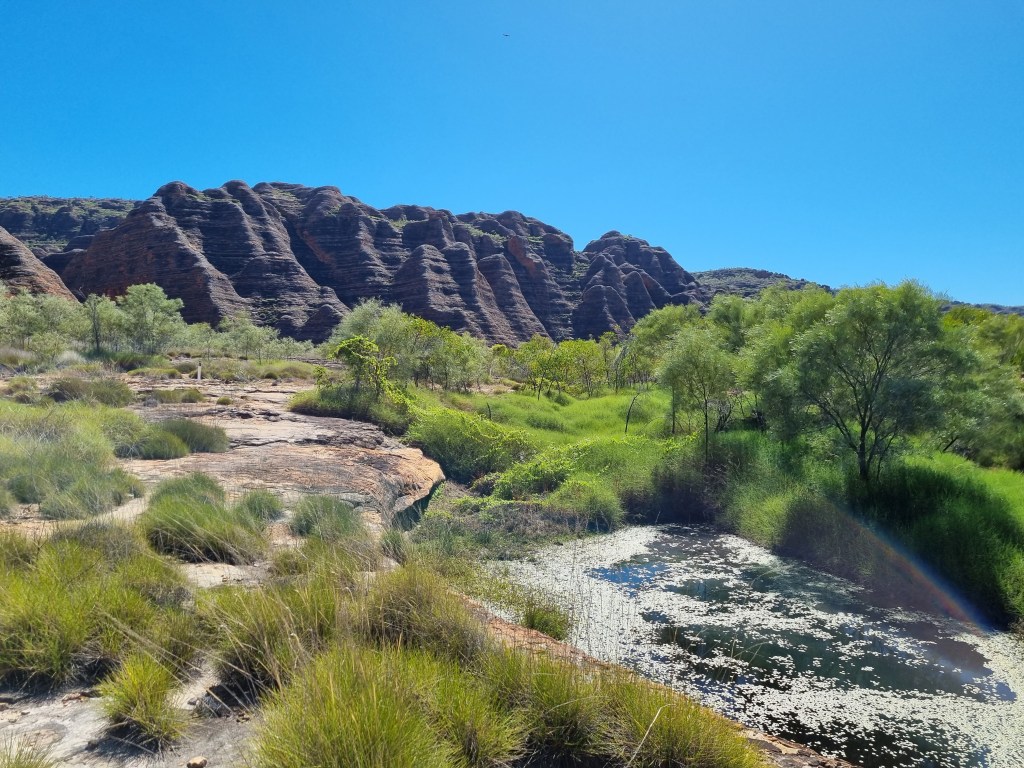
Walking down the creekbed is actually not about sand and pebbles but rock and pebbles. You just have to be a little careful as there are lots of fissures in the rock. There were also quite a few side bush-bashes to be made because of the pools of water that could prevent progress to the goal. Regardless as we got closer it was pretty special.
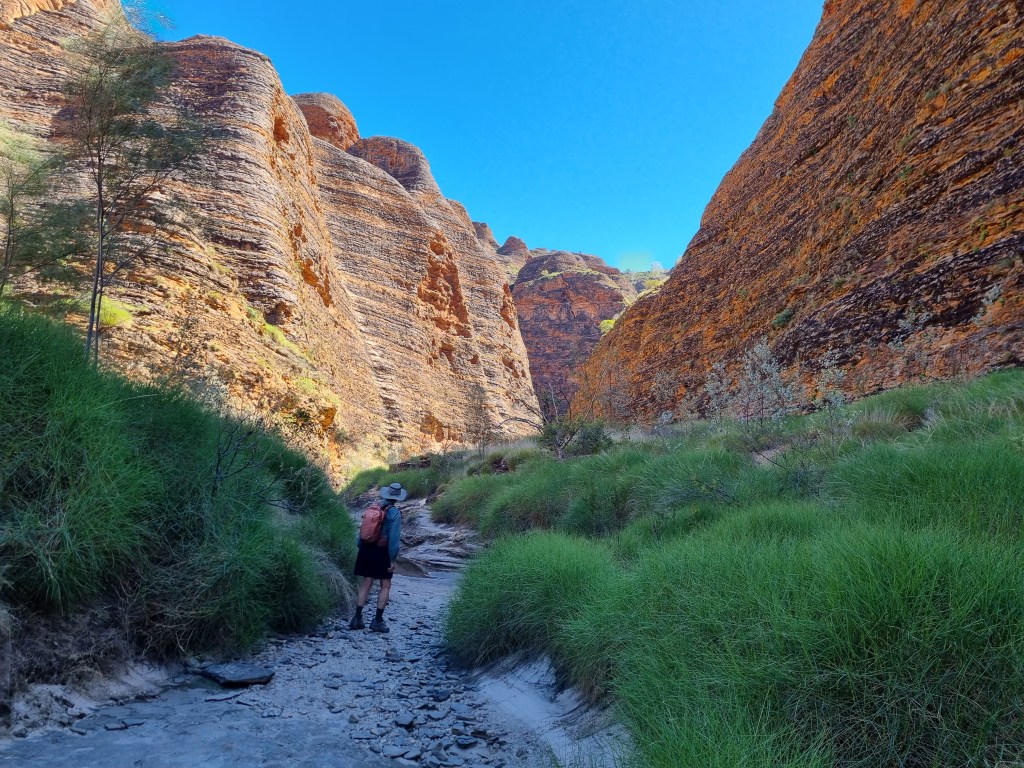
Arriving at the end it was indeed another amphitheatre. Looking at Judy scuttling across you can see just how big it was….awesome!
Week 3. Our time at Purnululu ends and we head back to Kununurra for a shower, to wash mud off the vehicle, to clean our kit and reprovision for the next stage. Hilariously I was writing this blog and wondered why Judy hasn’t come down to sit with me on the shore of Lake Kununurra. It seems the fellow next door to our camp was washing his car and a snake popped out of his grill. Only small, about 2 feet and quite skinny. Still, they chased it around and finally bagged and released it to the reeds nearby where it would be better placed. Funny things happen don’t they.
At the Lake Kununurra camp we have been assaulted every day by marauding Purple Swamp Hens. These normally reclusive quite big birds are nice to see at a distance. But they have learnt that the camp sites provide better food than the swampy areas where, to be frank, they would make a nice meal for what’s under the water. We are constantly sending them on their way and hiding anything that can be pecked over. Entering an open tent…no problem. Perhaps if I grant them the status of Bird of the Day, they will respect the sanctity of our camp. Perhaps not.
So, it’s off to the Victoria River Roadhouse and what we expect will be some beaut views of the Victoria River. The snakes follow us though, and we sight a couple more near the road as we drive along and then today one more. You can bet your boots I would never be tempted to head into the scrub here without my gaiters on at least….no not even that would assuage the fear of an imminent nip. At least at home you can spot them in the undergrowth, but here the grass is thick and high, and the blighters will be pumping the venom in before you can say …?
The roadhouse is reputed to be a good place to stay, and we were greatly disappointed to find it to be of the 1980s era. Filthy, grungy facilities and a dusty and horrid camp site. I would truly rather be out bush…. but for the gazillion snakes that are out there. Still, we tough it out as I really want to do the escarpment walk tomorrow.
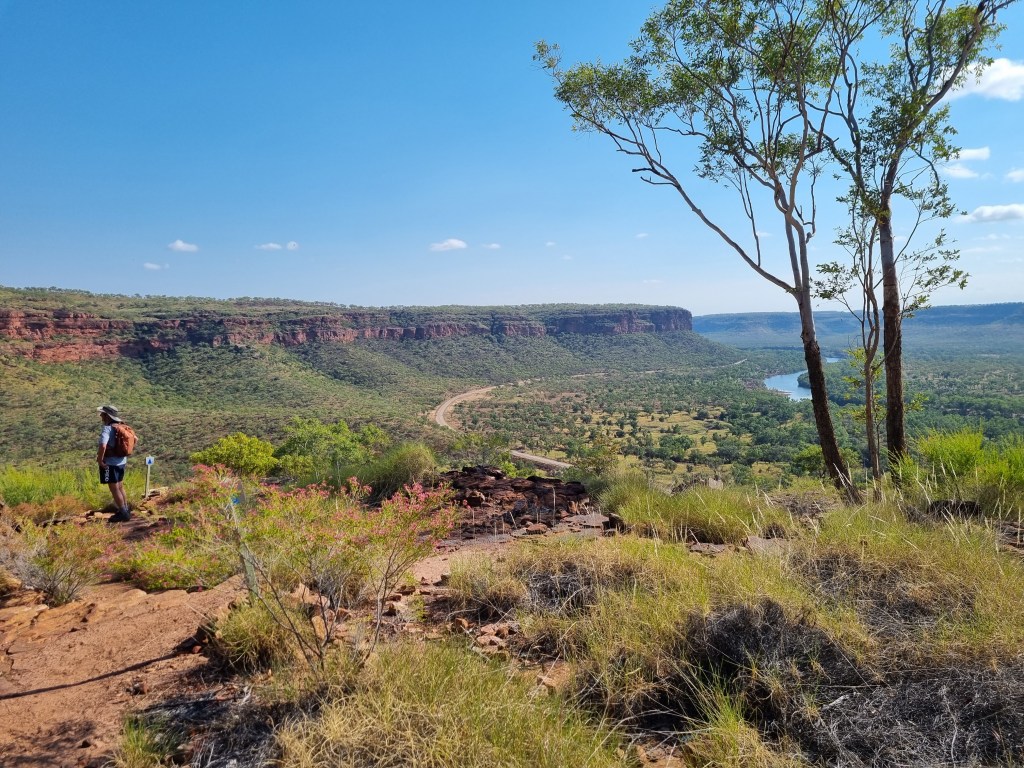
Heading up there are great views of what the Victoria River District is all about….you’ve got it…fishing! Barramundi in particular.
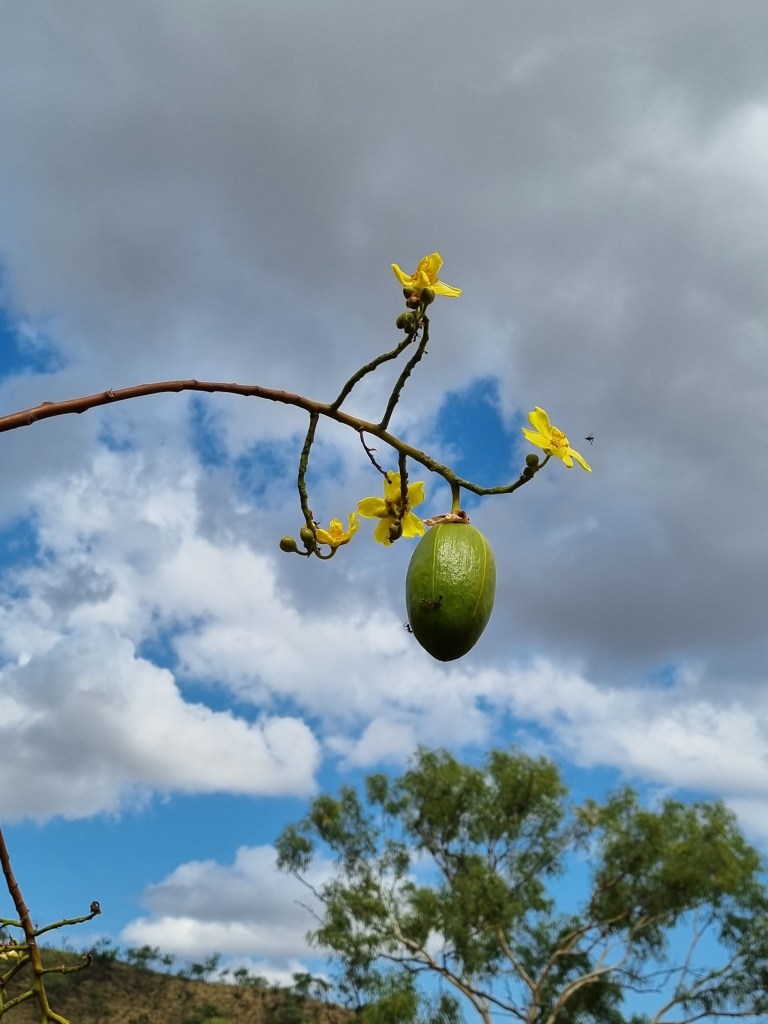
This video is not about Judy scrambling up what we call Fig Alley, but to show you just how adept Figs are at putting down their roots to get whatever water is around. In truth there are just so many trees and bushes here that we have no familiarity with. But two we noticed in particular, being Kapok trees which abound all over the place (left) and the Kimberley Rose or Sticky Kurrajong (right). The latter is the only one we have seen this trip, so what a treat just before we head off…see, the disgusting facilities we have endured are worth it!

This Old Victoria River Crossing pictured here was once the access to Gregory National Park until a flood tore the whole thing down. I would like to go down and paddle around to check it out but there are too many “snappers” around to take the chance. So, the pic only.

And so now we have left WA and are back in the NT at Katherine Gorge. It’s 35degs and about one million percent humidity. We popped in to get some decent coffee (being deprived for days) and to my absolute horror the trees are covered in roosting Bats !!!! Oh noooooo.
Bat Studies from Katherine Gorge: Ok so there were only a few poop parcels left as they mostly flew down the river overnight…thank God! Now these rather cute (actually large) bats called Goyn-bam are black with golden fur on the upper bodies. Their wingspan is 1 metre. Apparently, they are nice to eat…wonder if they will be on the menu tonight? In the top video you will probably see a mum trying to get her youngling sorted into a sleep position.
Later in the evening the bats started to muster to the skies. Funnily enough there seemed to be a pecking order. Thousands rose from the trees on the right whilst the bats still sitting in the trees in the foreground were clearly getting ready, flapping around and waiting their turn. This video may not show the foreground activity well, but it was most interesting.
Had to laugh last night as I tottered over to have a shower in very clean and decent facilities when a lady came darting out of her selected shower alcove. A rather large frog was hovering within plain sight and that was just too much… counselling may help…
Week 4. Camping at Katherine Gorge used to be great fun, but with the monstrous vans that are dominating this locale it’s lost much of its appeal. A humble camper here and elsewhere faces the prospect of being squeezed between these houses on wheels with their air-conditioning and lighting invading one’s personal space. Some even go to the trouble of erecting fairy lights. The option is a non-powered site, but these are only marginally better because motorhomes rather like these areas now. In truth tenting seems to be a thing of the past. The best option of course is a National Parks as without power these monstrous vehicles are toothless tigers.
On this trip we still decide to stay at Katherine Gorge, despite these impediments as we want a boat ride down the gorge to see the mighty cliffs; and we also want to do some walking. Sadly, all the tours were booked out way in advance and the walks are challenging because of the extreme humidity and heat. I just hate being a limp wet rag all day and night.
So we quickly decide to “get out of Dodge” and duck down to Elsey National Park near Mataranka. Humidity is manageable, its cool at night and unbelievably peaceful…well mostly. For some strange reason there are Donkeys in the vicinity, and they are squabbling loudly at night. Never mind it’s a delight to be here and it’s great to see the full moon rising from the horizon and popping through the trees.
At last, we can get out for a decent walk and accordingly head along a track to the Mataranka falls (Korowan). To do this you follow the Roper River down to tufa dams that cross it to form gentle rapids. These are created by calcium carbonate depositing on rock bars.
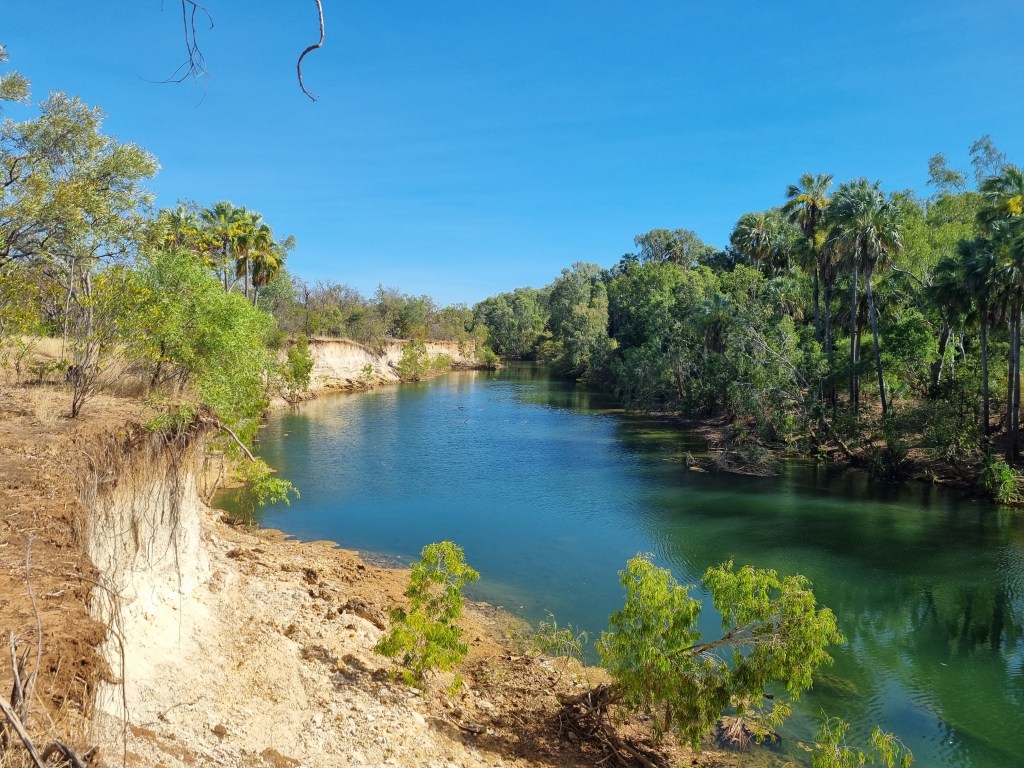
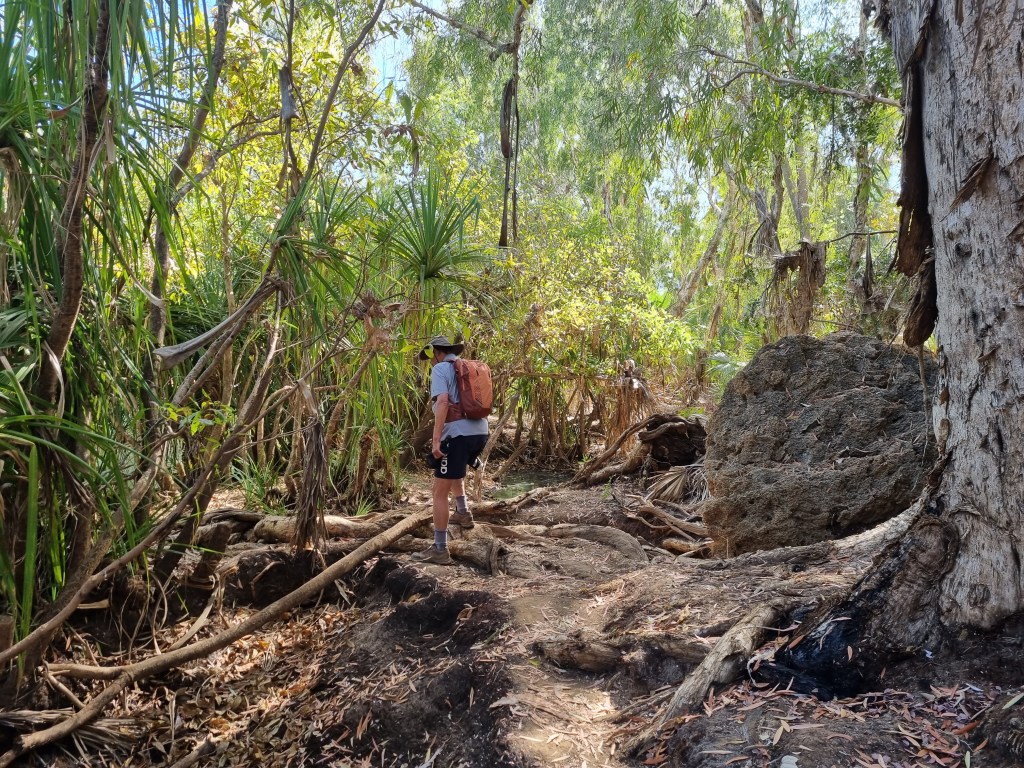

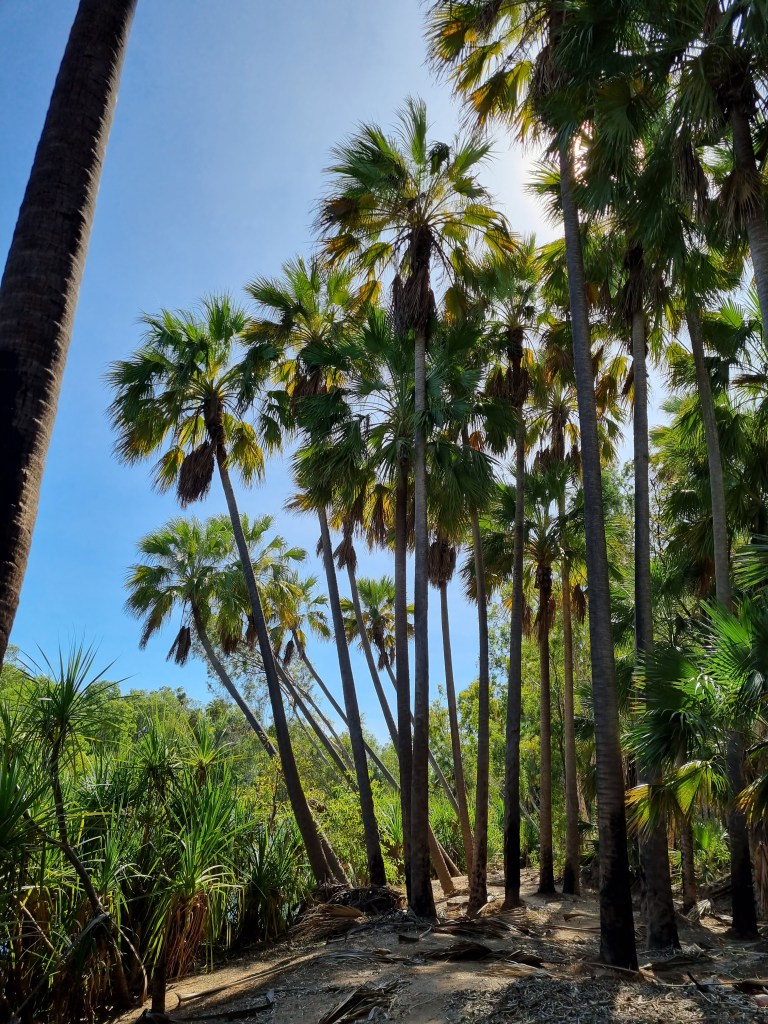
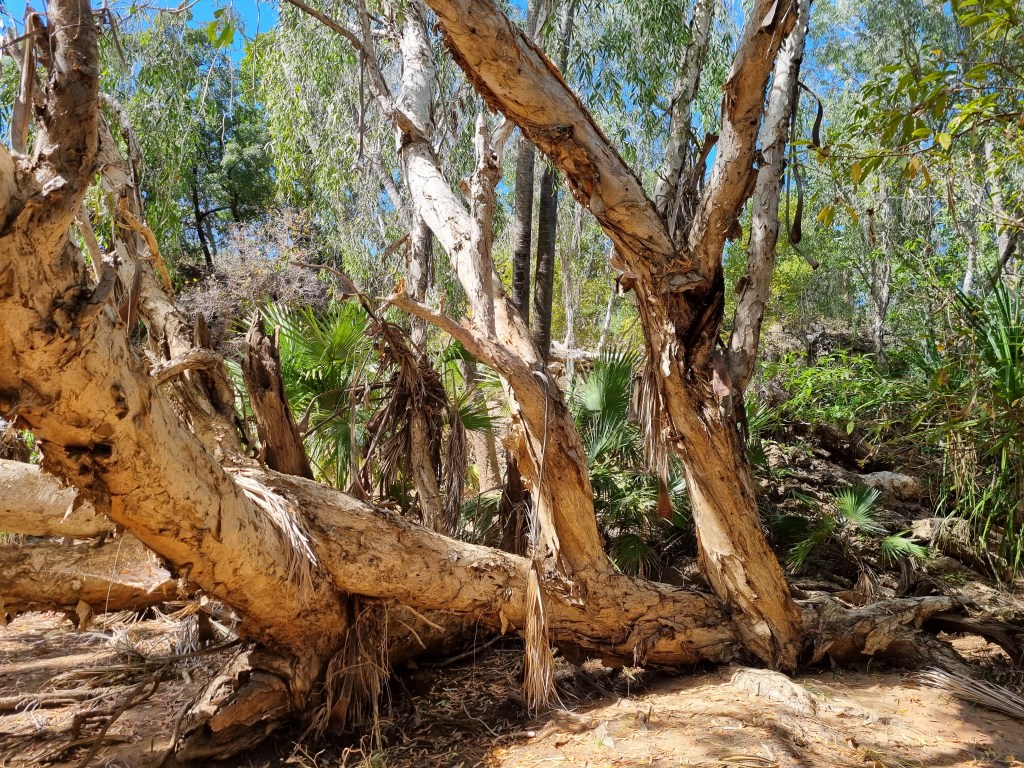
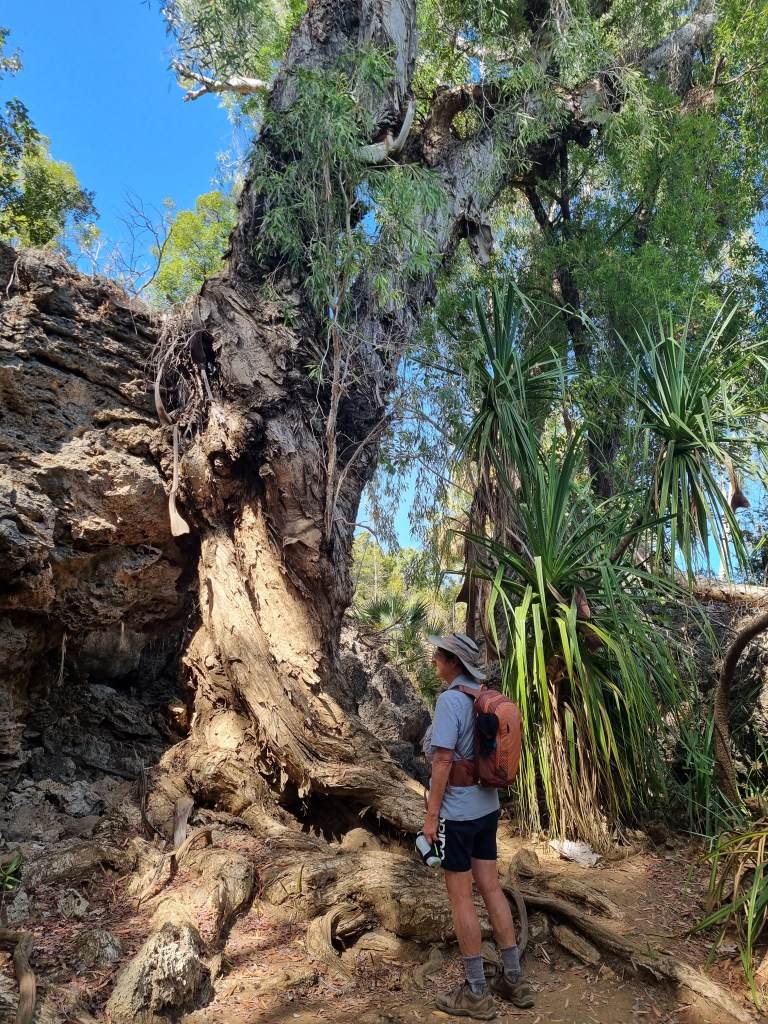
Walking past termite mounds we enter precincts of Palms and beautiful and some clearly very old Paperbark trees. They are just huge, and apparently their bark was used extensively to store food eons ago.

Termite mounds are just everywhere up here and come in any hue from bright orange, grey, to brown and shades in between. Some are tall and thin, and others look like overweight blobs. I haven’t seen any sign of the massive ones we passed on the Tanami desert track all those years ago. Those giants we extremely tall, about 5 feet wide or more. My understanding is that these monsters are also up in the Litchfield and Darwin region.

Today we walked around a Botanic loop (above) and then onto the township of Mataranka because one member of this team forgot to get some beer for our ritual lunch half glass … yes awfully we have run out. From henceforth today will be called the “B” day. Birds (by the dray load), Butterflies in great numbers, Brolgas who tottered across the road as I drove into Mataraka….and the pub with no Beer. Of course, we are in the NT! So, for their sins the Brolgas are the Birds of the Day, and I am sure you know exactly what they look like. They are huge grey water birds (over 1 metre tall) that have a red patch under the eyes. Quite stately really and they demonstrated by their behaviour that they owned the town as they sauntered down the main street.
Heading further South, we come to the Renner Springs Roadhouse where we are again accosted by the houses on wheels…never mind we are tough! This will do for the night.
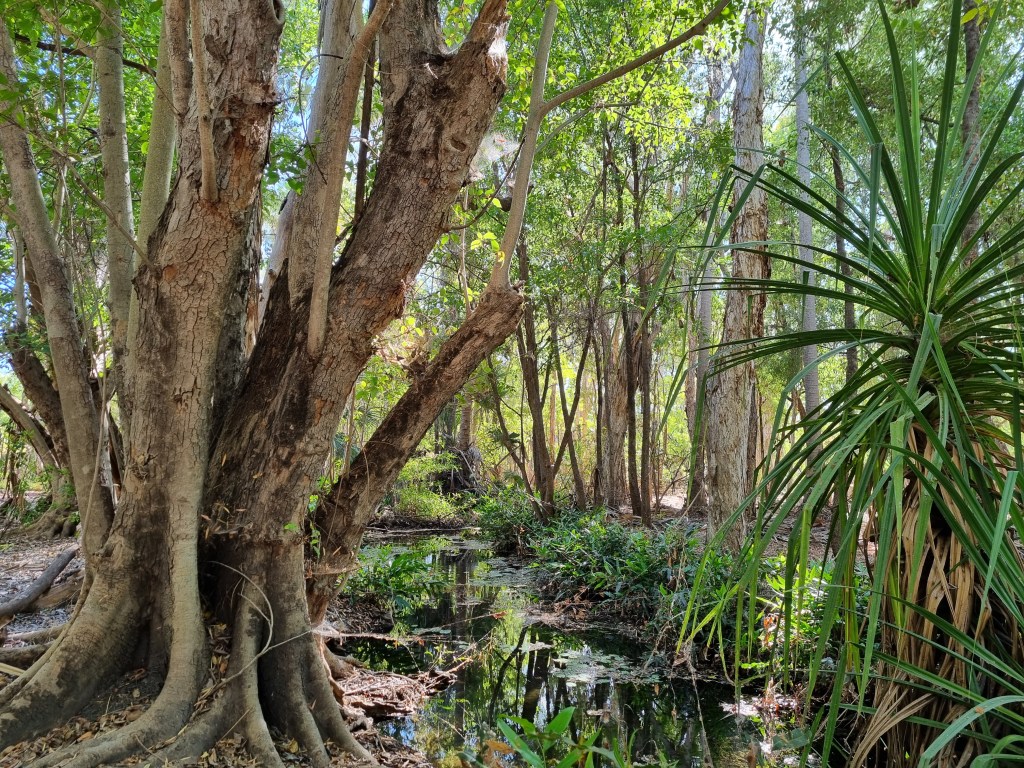
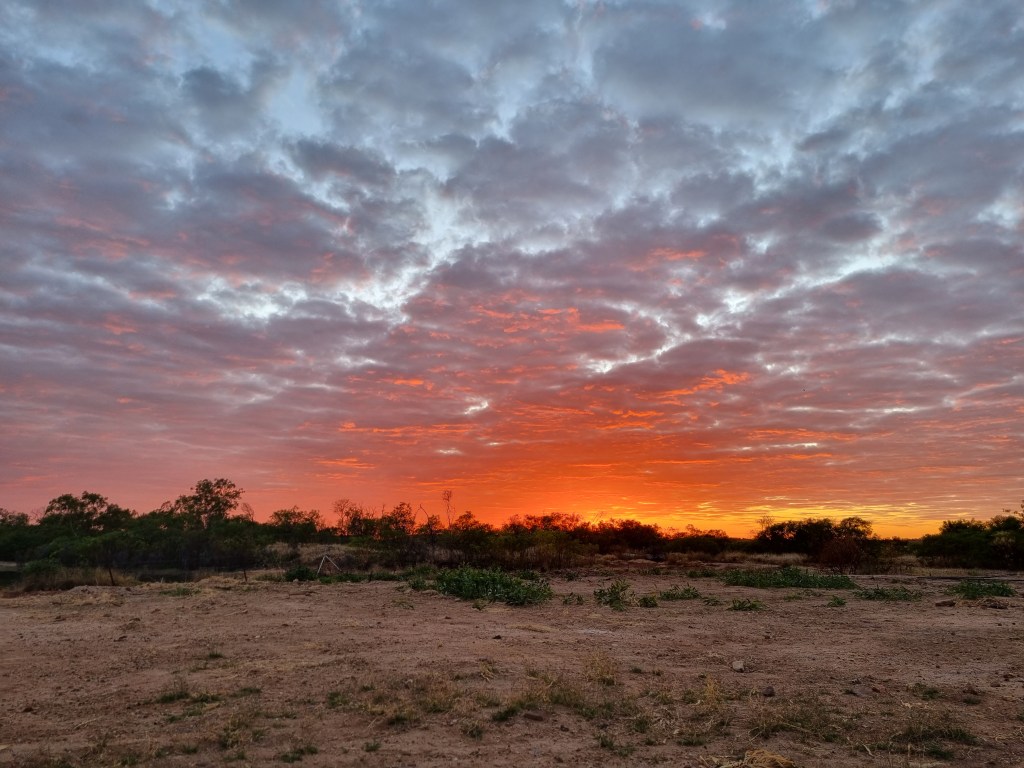
This morning we woke to a stunning sunrise and set about shortly after to do some birdwatching around the mound springs.
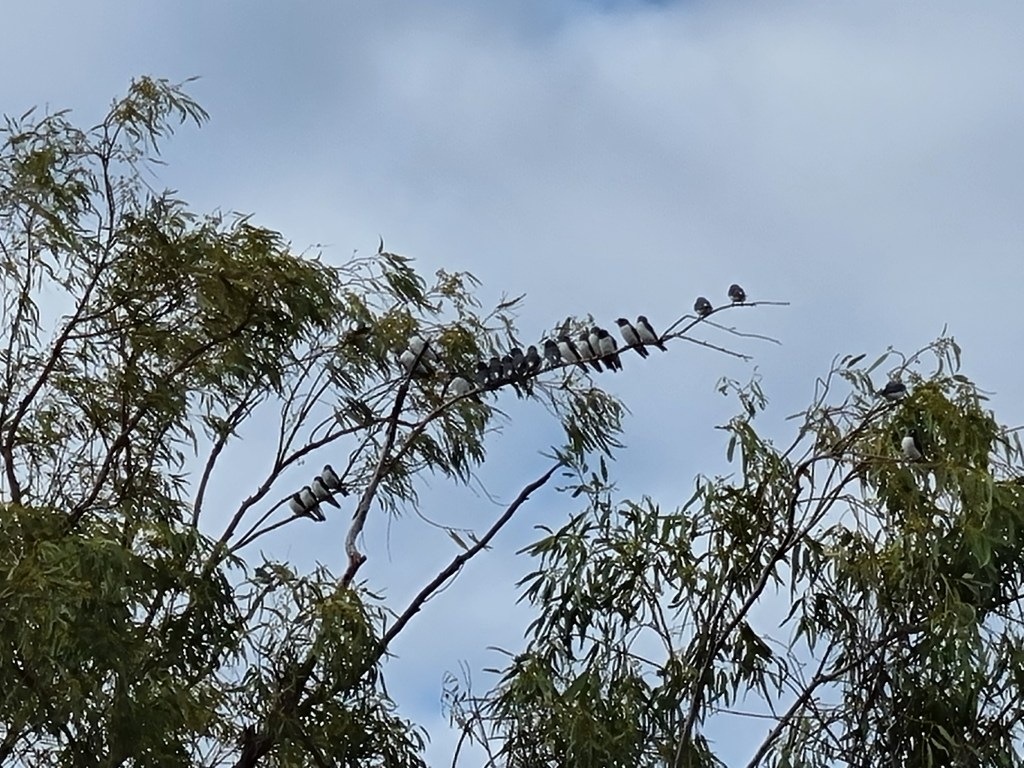
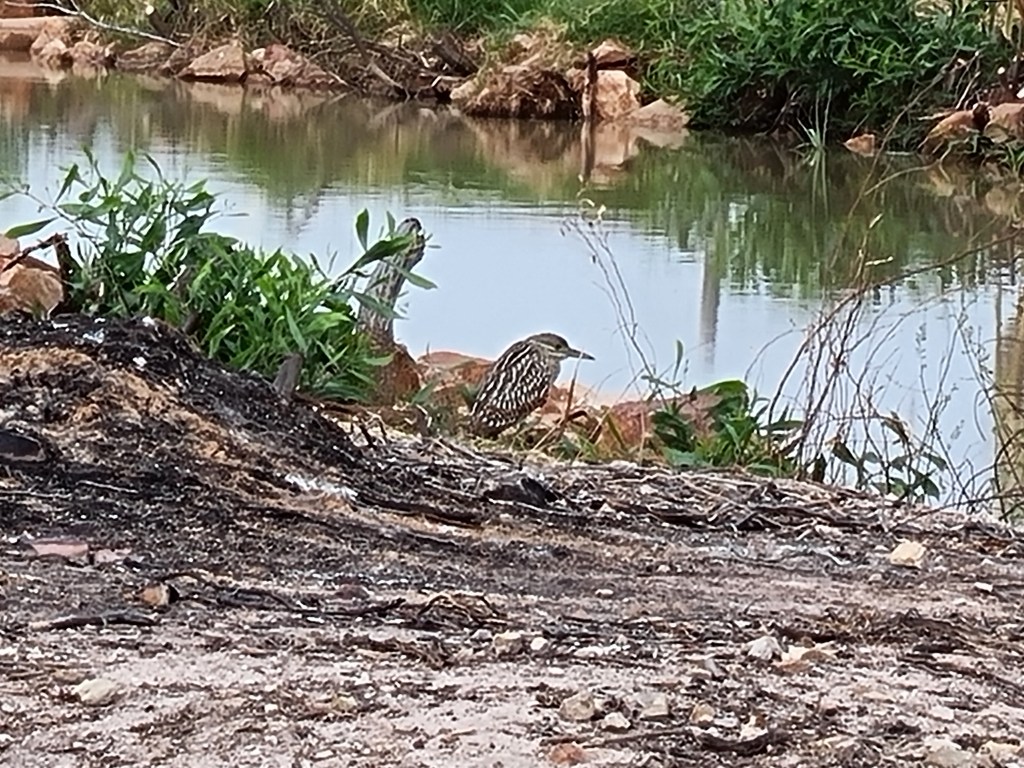
Now normally I don’t show pictures of birds as I just know it’s boring for some, but there are exceptions to any rule. Here are two wonderful Birds of the day…not good shots but you will get the drift.
White Breasted Wood Swallows like all such Swallows have a habit you never see in other birds. Believe it or not they line up together as if on parade (called clumping). They fly away and come back to cuddle up again. The other bird rarely seen during the day is the Nankeen Night Heron. This is a juvenile, who doesn’t know better obviously. Later he will turn orange with a black scalp. A beauty and its always a thrill to see them as you rarely do get the chance.
You can see we are back in the typically more arid NT zones now and as we head further south it will continue to be parched. The tropical North was beautiful, but we now enter more familiar zones for us. Once again, we pass by the Devils Marbles (Karlu Karlu) and take the time to drop in and have another look around.

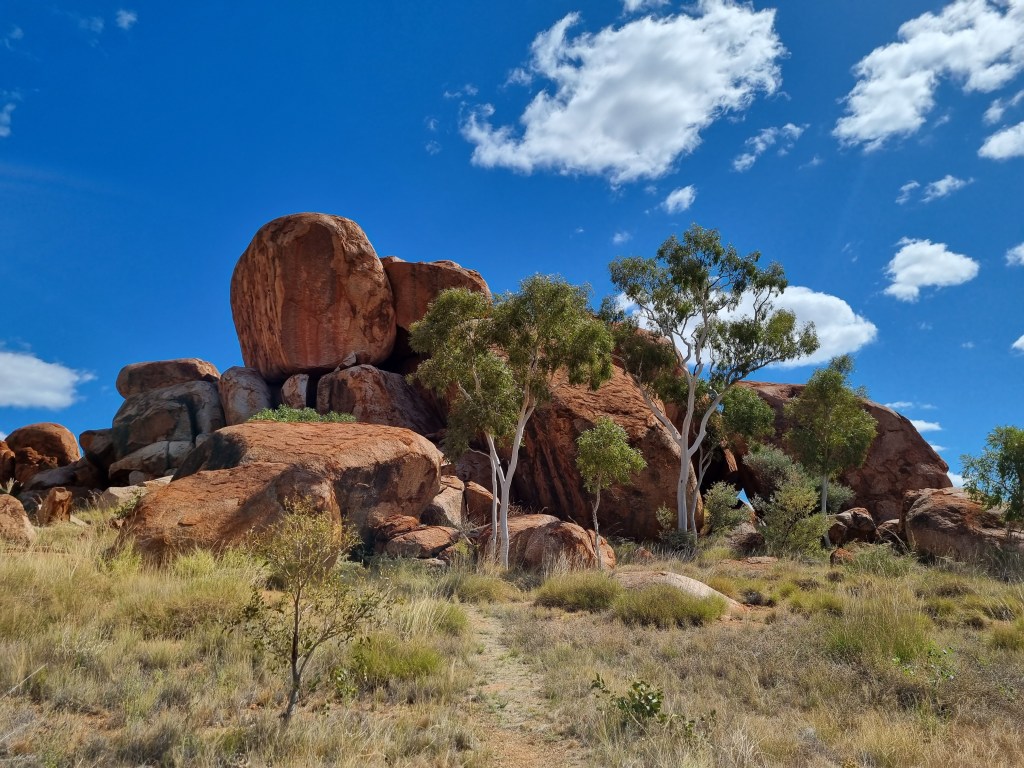
Shortly thereafter we arrive at Wauchope and settle in for the night. Interestingly the weather is now cooler at night and certainly the humidity has dropped off, which is a welcome relief. The more arid regions’ grasses, bushes and trees line our path South. There are a few Desert poplars around which is a delight.
We are surprised to see huge groups of Budgerigars and Cockatiels as we travel. In truth what you see in a backyard aviary is not what delights one senses out here. Instead, there are many very large groups (read hundreds) of brilliant green Budgies swooping in and out of the scrub and playing kamikaze with our car. This so reminds me of the time I drove the Canning Stock Route with friends and the delight we experienced in seeing thousands upon thousands of Budgerigars at the wells along the way. It was fascinating to see them rising en mass into the sky, landing for a short while on the ground or trees and then rising as one into the sky again. The fact that birds of prey were looking for an easy meal had everything to do with this behaviour.
You need to know many of the wells on the stock route are covered so the birds must find some access point and drink from the water which is quite a long distance down in the dark…clever I reckon.
Cockatiels are sadly another bird that people like to keep in captivity. Out here they are a delight to see as part of their natural habitat. These parrots are light grey with a yellow crest and a red patch on the cheek. They fly in small groups of about 10-15 and are captivating to see as they wheel around at breakneck speeds. Of course, both of these are my Birds of the Day. The Cockatiels I expected but the Budgies were a gift on this occasion as we don’t often see them in such numbers here. The wet year will have made all the difference.
Week 5: We are now back in the Alice after a night at Wauchope. It’s time to regroup and prepare for the next 1500 kms home. We expect to be at our property in the Riverland for the big cleanup on Thursday.
It’s tempting to think when we are travelling vast distances we would mentally switch off, read, listen to podcasts, music or anything to while away the boring hours. But you know that couldn’t be further from the truth as distance gives one the opportunity to observe changing landscapes. Our homeward journey from Purnululu will in the end be well over 3000kms, and no matter how many times we travel these roads we are enriched by the experience. We will have transitioned from subtropical zones to mulga woodland, salt/blue bush zones and arid plains. The botanical changes are simply amazing, and I so wish I knew this area of science well.
For this whole distance there are only two areas that require toughing it out, being the 50kms on either side of Coober Pedy and Pimba. Flat as a tac and somewhat akin to a “no man’s land”. These areas are nothing more than low lying scrub and grass as far as the eye can see. Oncoming cars provide immense relief for the eyes.
But then you get this:
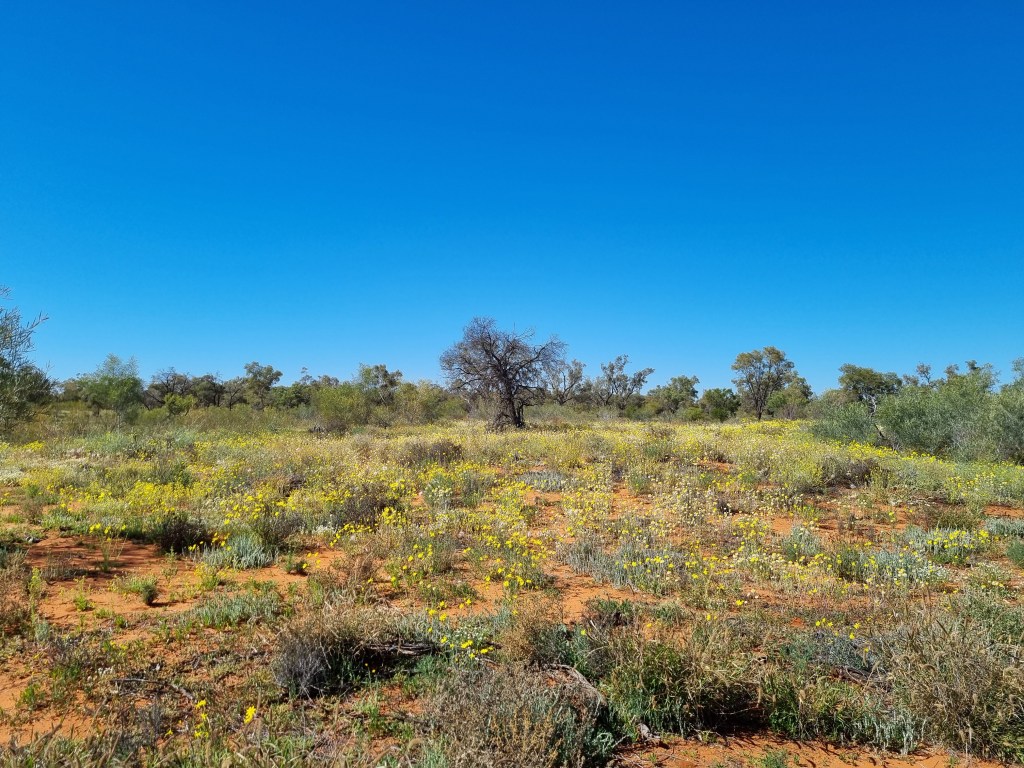
Now you know that there has been lots of rain this year. This means we have been gifted with huge tracts of land covered by yellow, white and purple flowers. As far as the eye can see in many cases. You may recall I did mention on the way up that I thought the wildflowers would be out soon…well here we are! The sheer beauty forces you to stop again and again to check out the varieties to be seen.
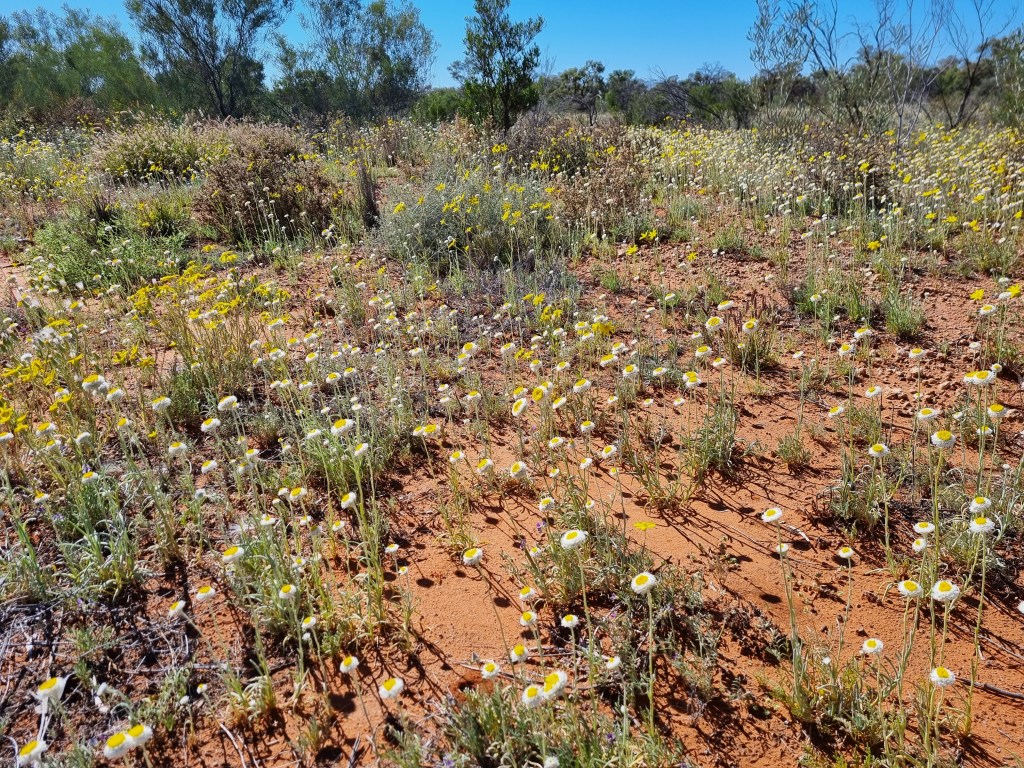
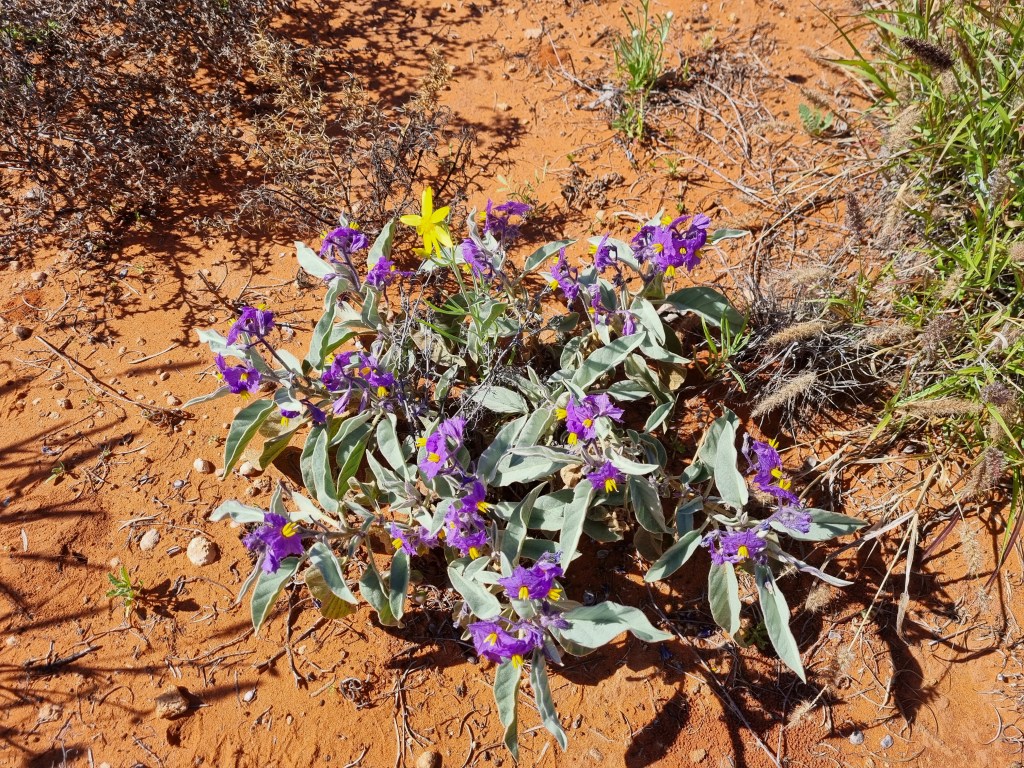
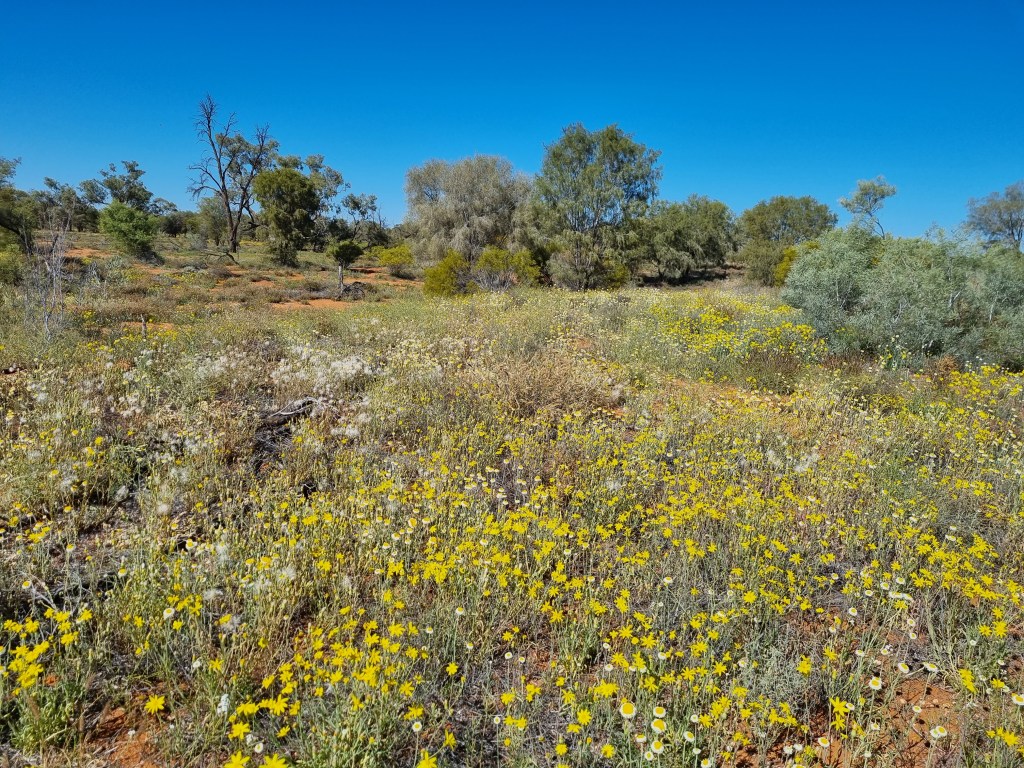
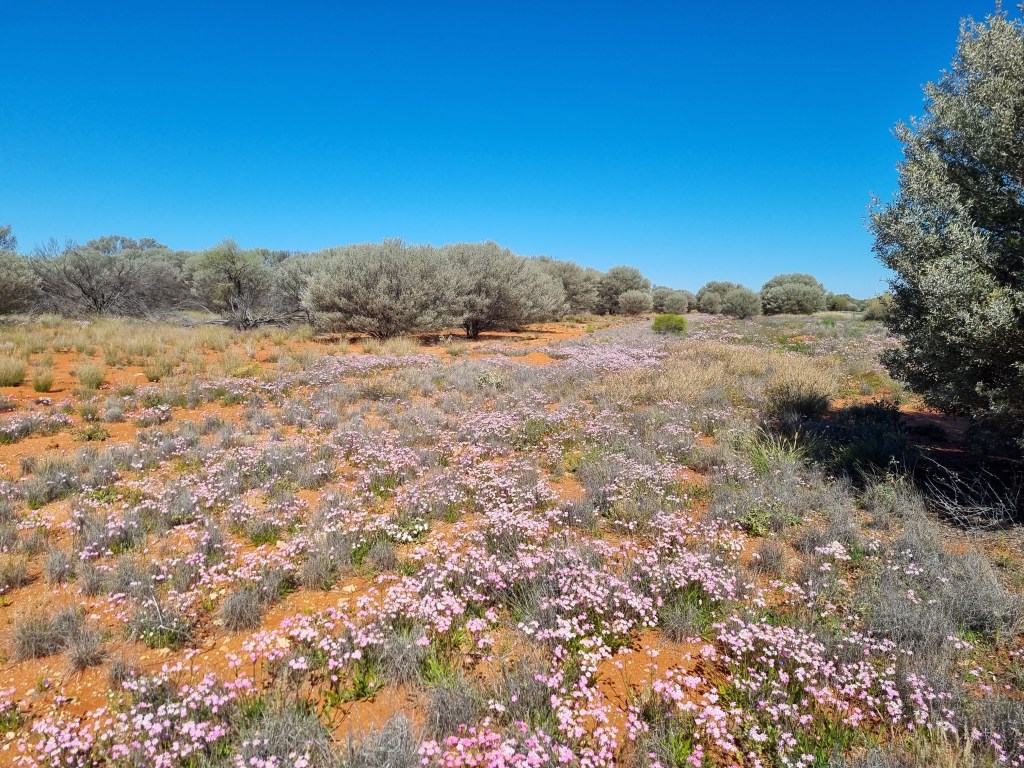
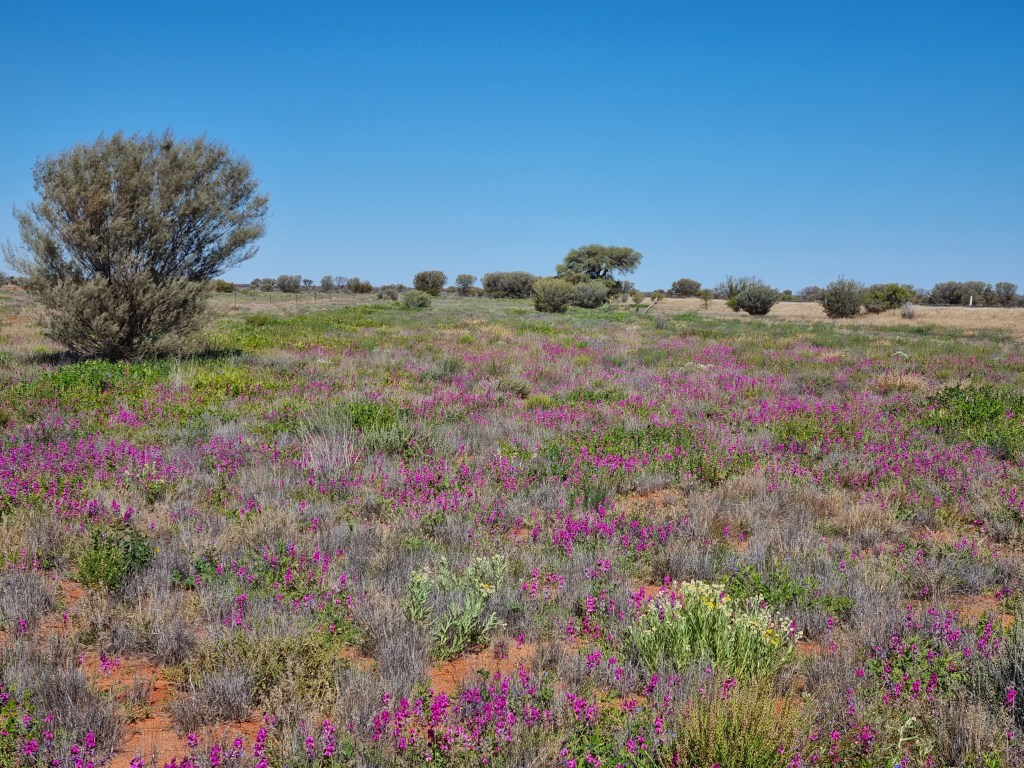
I do know I have gone over the top in terms of pics here, but I so want you to get a sense of the stunning landscapes we observed on our journey home. These wonderful “wildflower fests” occur rarely. What you see here is unlikely to be a feature again for many years…aren’t we blessed!
But it’s not just the ground flowers. As we also drove, we passed arcades of Senna (Cassia) and Wattle lush with bright yellow flowers. Even the Wild Tomato (the middle pic above) is to be found in abundance. I see these regularly out bush but have never ever seen such an abundance of so many healthy specimens. By the way these plants are called deadly nightshade by bushies….be assured I have never been tempted to eat the fruit.
But then it’s not just the flowers as the birds follow the pollen and insects. So far, we have identified over 100 species on this trip and today we heard a Chiming WedgeBill which provided our dawn alert before the other birds woke to the new day. What a thrill as we seldom hear these chappies. In the distance soon after a Crested Bellbird, Rufous Whistler, Rufous Songlark, and a Grey Butcherbird joined in. Now the reason we were able to hear these beauties was because we had left our nights’ accommodation before dawn because of the long distance planned for the day.
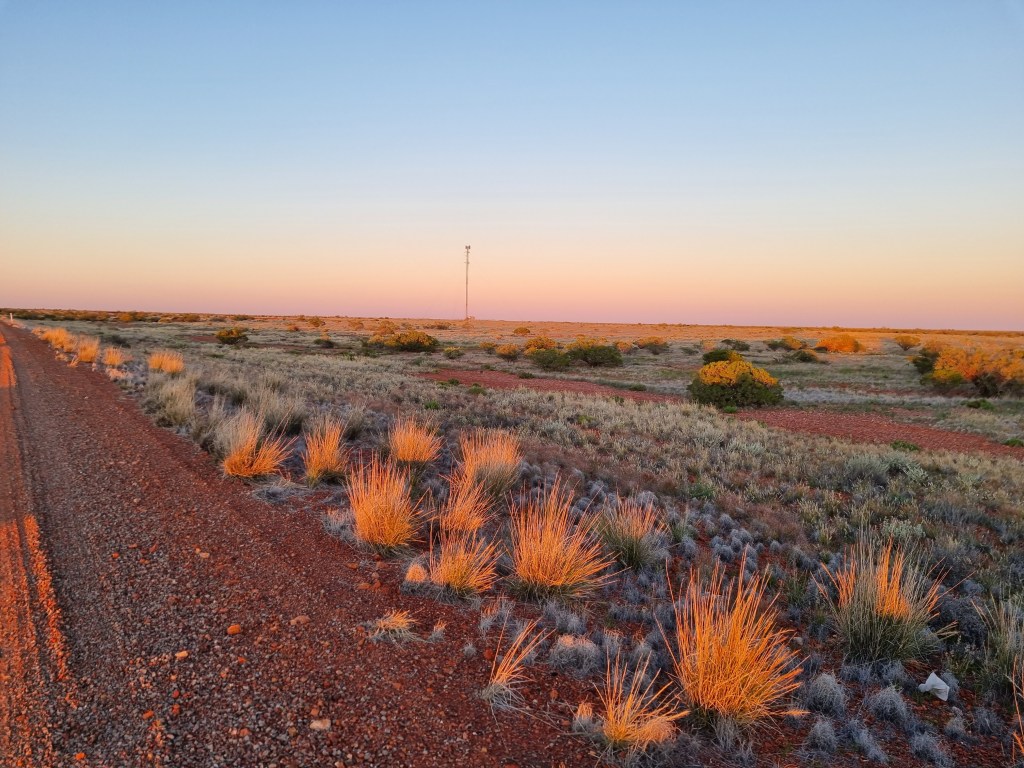
Horizons are vast up this way and one generally has an unimpeded 360-degree view to enjoy. Sadly, this ends today, and our wide vistas will become a thing of the past until we again head into remote areas once more. I hope this is sooner rather than later.
Distance travelled: 8250Kms. States visited SA, NT, WA. Vehicle damage: a cracked front windscreen (transports). Snakes spotted 5.
If you are interested in our next trip I can tell you, we are planning for Tasmania late December through to January 2024. The more rugged West Coast is the target…we shall see.
 Tramping and Camping